

Descript
★4.4Video ToolsEdit video and audio by editing text.
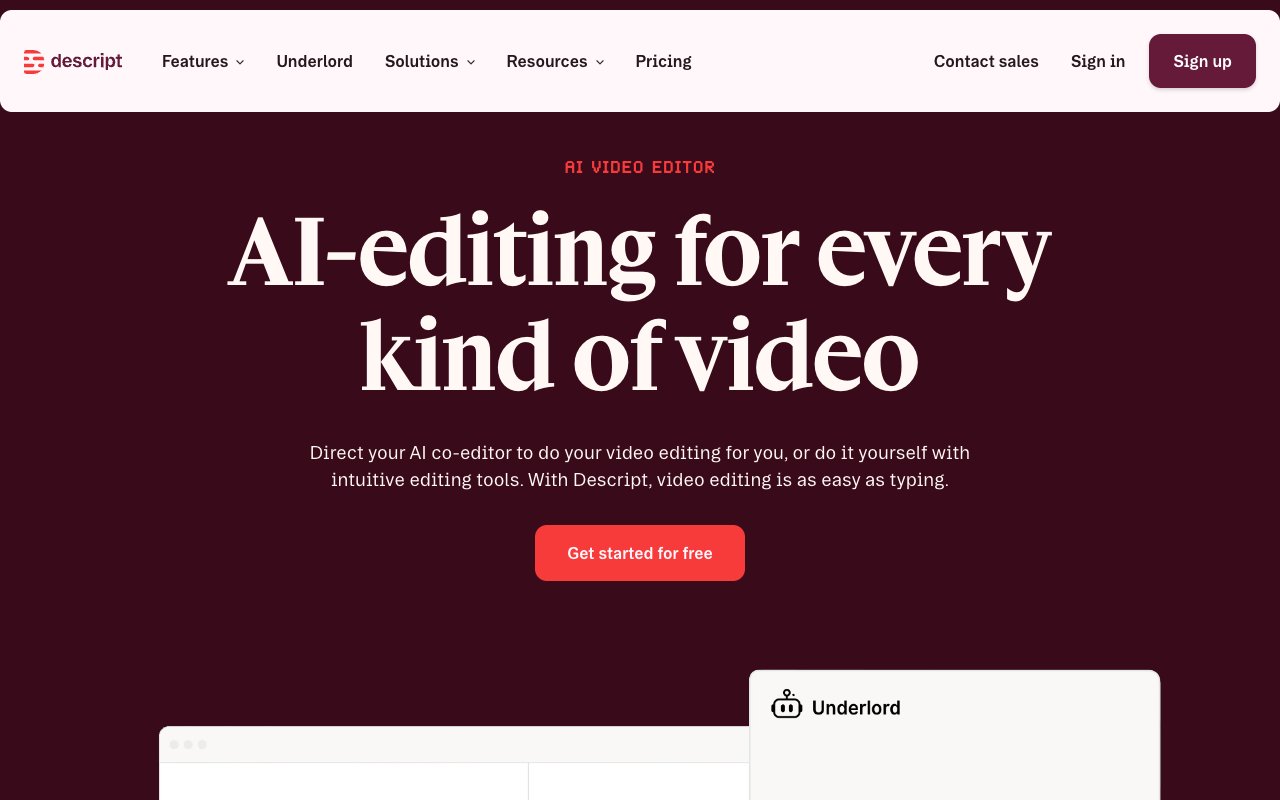
Descript turns audio and video editing into a text editing problem. Transcribe a recording, delete a sentence from the transcript, and that section disappears from the video. It also includes Overdub, an AI voice cloning tool that lets you correct mistakes by typing new words in your own voice.
| Category | AI Video Tools |
| Pricing | Free plan (1 hour transcription/month). Creator at $24/month. Business at $40/user/month. |
| Free plan | Yes |
| Best for | Podcast editing, YouTube video editing, Removing filler words automatically, Recording screen and camera simultaneously, Voice cloning for mistake correction |

Affiliate link — we may earn a commission if you sign up, at no extra cost to you.
Pros and cons
+ What works
- Edit video by editing the transcript — no timeline scrubbing required
- Overdub voice cloning corrects audio mistakes without re-recording
- Filler word removal (um, uh, like) works in one click
- Screen recorder, camera recorder, and editor in one tool
− Worth knowing
- Transcription accuracy drops on strong accents or technical jargon
- Not suited for cinematic or effects-heavy video production
- Overdub voice quality is good but not indistinguishable from your real voice
- Business plan at $40/user/month gets expensive for larger teams
What Descript actually does
Descript is a video and audio editor built around a single insight: most people can edit text faster than they can edit a timeline. When you import a recording into Descript, it transcribes the audio and displays it as a text document. To cut a section of your video, you select and delete those words from the transcript. The video cut happens automatically.
This makes a real difference for anyone editing talking-head content — interviews, podcasts, course recordings, YouTube videos, and online meetings. The traditional workflow requires scrubbing through a timeline, marking in and out points, and making frame-precise cuts. Descript replaces that with a workflow that resembles editing a Word document.
The free plan includes one hour of transcription per month — enough to evaluate the product but limiting for regular use. The Creator plan at $24/month adds unlimited transcription, Overdub voice cloning, and screen recording. Business at $40/user/month adds multi-user collaboration and higher Overdub character limits.
Descript handles video, audio, and screen recordings. You can record directly inside Descript (webcam, microphone, and screen simultaneously), edit the recording as a transcript, and export a finished video — all without leaving the application. For creators who also need something closer to cinematic production, Descript is not the right tool. It is built for speech-based content, not footage-heavy filmmaking. For that, [Runway](/tools/runway) handles the generative and cinematic side of video production.
The workflow is most effective for podcast editing, course creation, YouTube channels with a talking-head format, and anyone who records meetings or interviews for publication. Full feature documentation is at [descript.com](https://www.descript.com).
Transcription accuracy
Descript uses its own transcription engine, built on Whisper-based models with additional post-processing. Accuracy on clear English speech from a decent microphone sits at around 95–97%, which is high enough that most sentences come through correctly and editing the transcript requires minimal manual correction.
Accuracy degrades in predictable circumstances: strong regional accents, heavy background noise, multiple overlapping speakers, and technical vocabulary that does not appear in training data. A medical professional discussing specific drug names or a software engineer using obscure framework terminology will see more transcription errors than a generalist podcast.
For most content creators recording in a quiet environment with a USB or XLR microphone, the transcription is accurate enough to use as the primary editing interface. Descript also allows manual transcript correction: click on a word to jump to that point in the audio and retype the correct version. The corrected transcript stays tied to the audio.
One practical use of high-accuracy transcription is generating captions and subtitles. Descript can export an SRT file from the transcript, which you can drop into YouTube, a social media post, or a video hosting platform. For long recordings, this saves a significant amount of manual captioning work.
Descript does not support real-time transcription. You record or import first, then transcribe. For live captioning during a meeting, a dedicated transcription tool is more appropriate. Descript is designed for post-production editing.
Overdub: fixing mistakes without re-recording
Overdub is Descript's AI voice cloning feature. You train a voice model on roughly 10 minutes of your own speech, then use that model to generate new audio in your voice by typing text. The primary use case is correcting mistakes in recorded content.
If you say the wrong word in a podcast recording, the traditional fix is re-recording that section and editing the new audio in. Overdub lets you delete the mistake from the transcript, type the correct word, and generate it in your voice at the right pitch and pace for the surrounding audio. The result is not perfect — careful listening can often detect the substitution — but for a word or short phrase in context, it is usually convincing enough.
Overdub is available on the Creator plan ($24/month) and above. Descript limits what you can generate with Overdub — you can only generate audio in your own trained voice, not in other people's voices. This is a deliberate policy to reduce misuse, though it limits creative applications.
For podcast producers who regularly need to correct misspoken names or fix awkward phrasing without re-recording a full episode, Overdub is a genuine time saver. For video content where lip sync matters, it is less useful — a voice correction that sounds right in audio will still show the speaker's mouth out of sync on screen.
For teams that need more advanced AI voice generation — generating new content in custom voices for other use cases — [ElevenLabs](/tools/elevenlabs) offers higher-quality voice synthesis with broader applications, as a separate specialist tool.
Filler word removal and Studio Sound
Descript removes filler words — um, uh, like, you know — automatically across an entire recording in one action. It scans the transcript, highlights every detected filler word, and removes them all on confirmation. Most podcast editors spend significant time hunting these manually; Descript removes them in under a minute.
The detection accuracy is imperfect. It occasionally removes a meaningful use of "like" or misses a filler word transcribed oddly. The result still needs a review pass, but that review is much faster than doing the entire job manually.
Descript also includes Studio Sound, which removes background noise, room echo, and microphone inconsistencies from audio. The effect is real: a recording made in a reverberant room or with audible air conditioning noise comes out noticeably cleaner. Studio Sound does not turn a bad microphone into a professional one, but it raises the floor of acceptable quality. For creators who record in imperfect home environments, this feature alone justifies part of the Creator subscription.
The combination of filler word removal and Studio Sound handles most of the tedious audio cleanup in podcast production without needing a separate audio editing tool. For advanced audio work — EQ, compression, multi-band dynamics — a dedicated digital audio workstation is still needed. Descript handles quick cleanup; it does not replace Audition or Logic Pro. The [Descript help centre](https://help.descript.com) documents Studio Sound settings in detail.
For video producers who also need AI-generated footage alongside their talking-head content, pairing Descript with [Runway](/tools/runway) covers both editing and generation in a complementary workflow.
Who should not use Descript
Do not use Descript for cinematic or effects-heavy video production. It is built for speech-based content — podcasts, interviews, course recordings, and screen captures. If you are cutting multi-camera footage, colour grading, adding visual effects, or working with B-roll-heavy storytelling, Descript will frustrate you. For that kind of production, [Runway](/tools/runway) handles AI-assisted video and traditional editors like DaVinci Resolve handle complex timelines.
Avoid Descript if your recordings contain heavy background noise or strong accents and transcription accuracy is critical. At 95–97% accuracy on clean English speech, the transcript-based editing workflow works well. At 80% accuracy on difficult audio, you spend more time correcting the transcript than editing a timeline directly would have taken.
Do not pay for the Business plan at $40/user/month if you are a solo creator. The Creator plan at $24/month has everything an individual needs — unlimited transcription, Overdub, and Studio Sound. The Business plan adds multi-user collaboration and team features that only matter if multiple editors work on the same projects.
And if your primary need is live meeting transcription in real time, Descript is the wrong tool. It is a post-production editor. For automatic meeting notes and real-time transcription during calls, a dedicated transcription service is more appropriate for that specific use case.
Our verdict
Descript
★4.4Descript turns audio and video editing into a text editing problem. Transcribe a recording, delete a sentence from the transcript, and that section disappears from the video. It also includes Overdub, an AI voice cloning tool that lets you correct mistakes by typing new words in your own voice.
Best for
Podcast editing, YouTube video editing
Pricing
Free plan (1 hour transcription/month). Creator at $24/month. Business at $40/user/month.
Frequently Asked Questions
Descript compared to alternatives

Tovorify Editorial
Who reviews these tools →