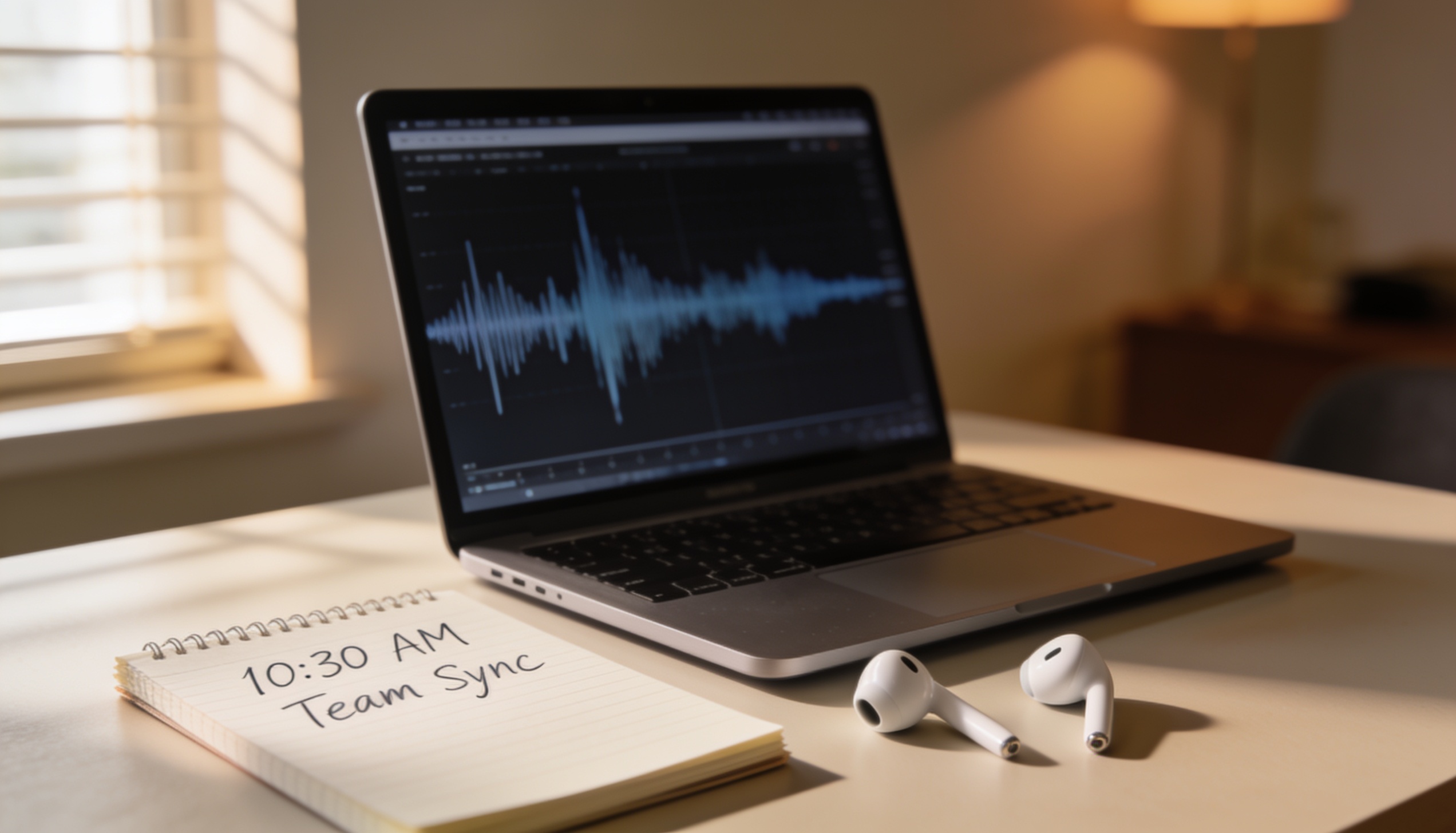
Three AI transcription tools cover most needs in 2026. Otter AI handles live meeting notes if your week is full of Zoom calls. Descript handles transcription for video and podcast creators who want to edit audio by editing text. Fathom handles meeting notes for free, with no meaningful limit on usage.
The rest of the category — Fireflies, Rev, tl;dv, Notta — fill specific gaps. Fireflies when your team uses CRM or Slack heavily and needs meeting notes to flow directly into those systems. Rev when you are in legal, medical, or regulatory work where 83% accuracy is not acceptable. tl;dv when you want meeting summaries without joining every call yourself. For most individual users and small teams, evaluating three tools is enough.
The two transcription workflows that most lists conflate
"AI transcription" describes two workflows with different requirements, and most roundup articles compare tools across both without acknowledging the split.
Meeting transcription is real-time: a bot joins your Zoom or Google Meet, records audio as the call happens, and produces a live transcript and summary after it ends. The value is speed — notes appear while you are still on the call. Accuracy matters less than it does for file-based work because the humans in the room already understood what was said. The transcript is a reference, not the record.
File transcription works differently. You upload a pre-recorded audio or video file, the tool converts it to text, and you need that text to be accurate because you often cannot re-listen to verify every word. Legal depositions, medical notes, podcast transcripts, recorded interviews — these workflows have accuracy requirements that meeting notes do not.
Most "best transcription" roundups mix the two categories and compare tools across both. Otter AI and Fathom are meeting tools. Rev is a file transcription tool. Descript is a video editing tool with transcription built in. Comparing Otter AI to Rev on raw accuracy is not a useful comparison for choosing a tool — they solve different problems for different workflows.
The split determines which tools are relevant. If you spend most of your week in video calls, meeting tools are the category. If you upload pre-recorded audio or video files regularly, file transcription tools are the category. If you produce talking-head video or podcasts and want transcription as part of the editing process, Descript is the category. Most people fall clearly into one of these three groups.
| Tool | Best for | Free plan | Starting price |
|---|---|---|---|
| Otter AI | Live meeting notes | Yes (300 min/mo) | $16.99/mo |
| Fathom | Free unlimited meeting notes | Yes (unlimited core) | $19/user/mo |
| Fireflies | Teams + CRM workflows | Yes (800 min storage) | $10/mo |
| Rev | High-accuracy file transcription | Yes (45 min/mo) | $25.49/user/mo |
| Descript | Video and podcast editing | Yes (1 hr/mo) | $16/user/mo |
Otter AI — for live meeting captions

Otter AI is the most widely used AI meeting transcription tool in the US. The free plan — 300 minutes of meeting transcription per month, live captions inside Zoom, Google Meet, and Microsoft Teams, and a searchable archive of past meetings — explains the adoption. The Pro plan at $16.99 per month ($8.33 per month on annual billing) raises the limit to 1,200 minutes and adds AI meeting summaries and action item extraction.
What Otter AI does well is the real-time experience. Captions appear as the meeting happens, speaker labels identify who said what, and a summary arrives in your inbox within minutes of the call ending. You can add comments directly to the transcript during the meeting, highlight important moments, and share the full recording with teammates who were absent. For someone who attends multiple meetings per day and wants notes without writing them, that workflow runs on its own after an initial calendar connection.
The accuracy limitations are specific. In independent testing, Otter AI's accuracy runs around 83% on clear English audio — roughly 1 in 6 words may be wrong. On calls with heavy accents, technical jargon, multiple simultaneous speakers, or poor audio quality, accuracy drops further. For a meeting note where the people in the room remember what was said, 83% is workable. For a legal or medical record that needs to stand without the humans present, it is not.
Language support is limited to English, French, Japanese, and Spanish. If your team runs calls in German, Portuguese, Mandarin, or other languages, Otter AI does not cover them. Fireflies and Fathom handle a broader language set.
One compliance note: in August 2025, a class action lawsuit was filed against Otter AI related to how it discloses recording to external call participants. The case is ongoing. If you are in a regulated industry or regularly record calls with clients who are not expecting a transcription bot, review Otter's consent disclosure behavior against your state's recording consent laws before deploying it broadly.
For Notion users who take meeting notes manually, the Otter AI vs Notion AI comparison covers the practical difference between those two approaches to meeting documentation.

Fathom — the best free option for meeting notes
Fathom became the most-recommended free meeting notes tool in 2025 and held that position into 2026. The core difference from Otter AI is simple: Fathom's free plan has no meaningful usage cap. Unlimited meetings, unlimited recordings, unlimited transcription — available without a subscription.
The free plan includes AI-generated summaries structured around action items, decisions made, and follow-up tasks. That structure is more useful than Otter AI's default format for most people who attend meetings to track what needs to happen next rather than keep a verbatim record. The summary arrives within a few minutes of the call ending and can be copied directly into an email or shared via a link.
Fathom joins meetings as a bot after you connect your calendar. Setup takes a few minutes; after that it runs without any per-call action required. After a meeting ends, you receive the summary and full transcript. Short highlight clips from the recording can be shared with teammates who were not on the call.
The Team plan at $19 per user per month adds analytics, CRM integrations (Salesforce, HubSpot, Salesforce Activity Logging), and collaborative features. For individual users and small teams where the primary need is personal meeting notes, the free plan covers it fully.
Fathom is a live meeting tool only. You cannot upload a pre-recorded file for transcription. If you want to transcribe a recorded interview, a podcast episode, or any audio you have already captured, Fathom does not support that workflow. Rev or Descript handle it.
Fireflies — for teams that need CRM and Slack integration
Fireflies is the better choice when meeting notes need to connect automatically to the rest of your team's workflow. The free plan includes 800 minutes of storage, basic AI summaries, and access to the meeting archive. The Pro plan at $10 per month (billed annually) adds unlimited transcription, more detailed AI summaries, and integrations with Salesforce, HubSpot, Slack, Notion, and 40+ other tools.
For a sales team where every customer call needs to be logged in CRM with action items attached, the integration layer is the value. Otter AI's CRM connections are less mature. Fathom covers Salesforce and HubSpot on its paid plan, but Fireflies gives more control over how meeting data maps to CRM fields and contact records.
Accuracy runs higher than Otter AI in independent comparisons. Multiple testing sources report Fireflies producing more accurate transcriptions and more structured meeting summaries on calls with clear audio. The interface is more complex than Fathom's, but teams that need the integration layer typically find the tradeoff acceptable.
tl;dv is worth considering alongside Fireflies for a different use case: asynchronous meeting review. tl;dv records and transcribes calls, and lets you create short highlight clips from meeting recordings to share internally. The free plan includes unlimited recordings and basic summaries. tl;dv fits teams that share meeting highlights asynchronously more than teams that need systematic CRM logging. If CRM integration is not a requirement, tl;dv's free plan is more generous than Fireflies'.
Notta is another alternative worth noting for teams that regularly hold multilingual calls. Notta supports 58 languages for transcription and live translation between languages during calls, which neither Otter AI nor Fireflies handle well on their standard plans.
Descript — transcription inside an editing workflow
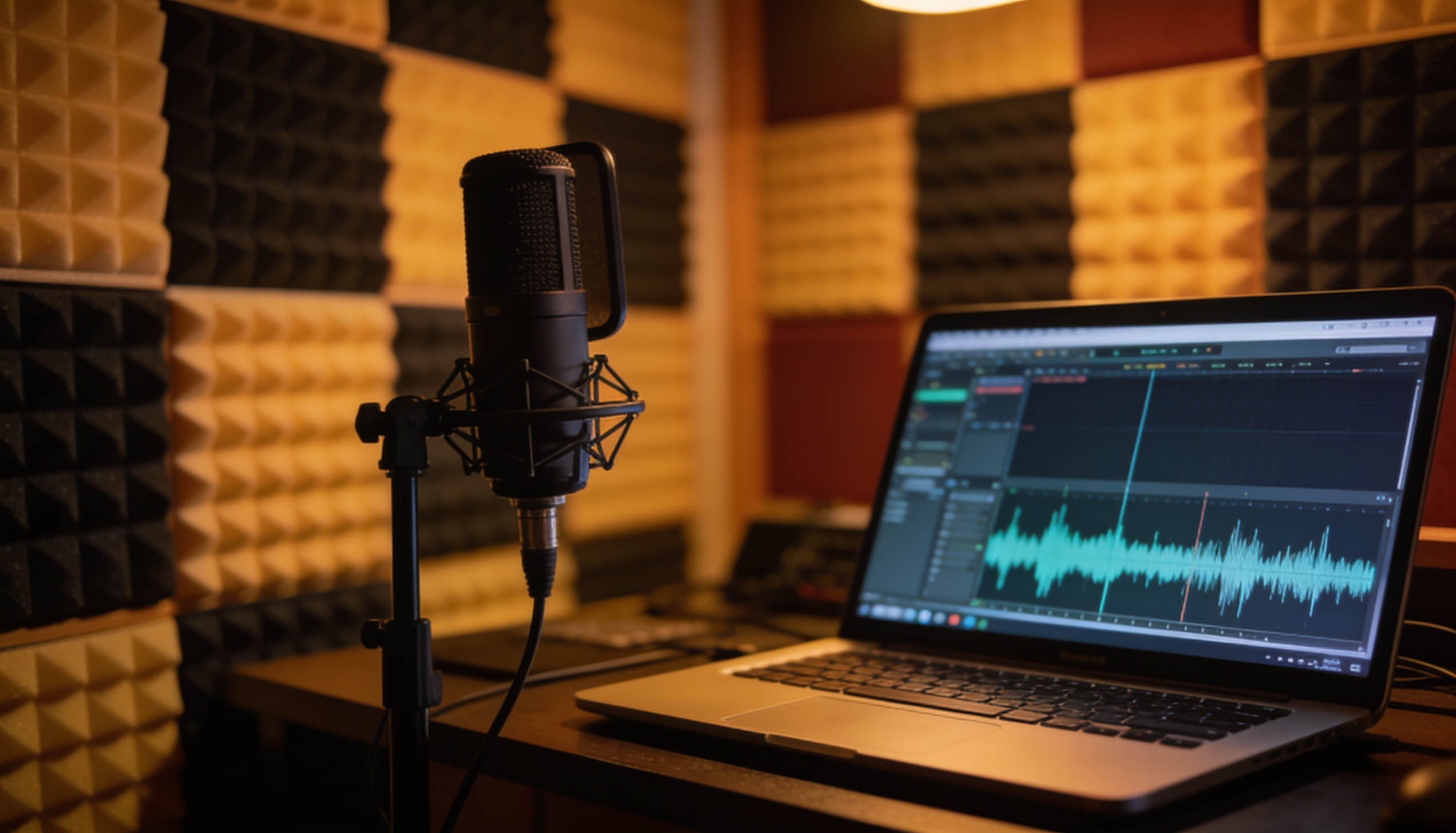
Descript is not a transcription tool that also does editing. It is an editing tool where transcription is the mechanism for editing. That distinction matters: if you want to edit audio or video by editing text, Descript is the only tool that does this in a practical way at the price point.
The workflow: upload a recording, Descript transcribes it in seconds, and you edit the media by editing the text. Delete a sentence from the transcript and the audio disappears from the timeline. Rearrange paragraphs and the audio reorders to match. Filler word removal — eliminating every "um," "uh," and "like" in one click — runs across any length recording without manual work. A 45-minute raw interview that needs to become a 12-minute podcast episode takes roughly the time it takes to read through the transcript once and delete what does not belong.
Descript's additional AI features in 2026 include Studio Sound (removes background noise and room echo from any recording), Overdub (re-record a line using your AI voice without going back on camera), and eye contact correction (adjusts gaze to appear looking at the camera even when reading from a teleprompter). These address production problems that previously required a re-shoot or a professional audio engineer.
The transcript Descript produces is also useful as a standalone document. Podcast show notes, YouTube video descriptions, and closed captions all start from the same transcript the editor already reviewed during the edit. For solo creators managing the full content pipeline, that reuse saves several additional hours per week.
Pricing: the free plan includes 1 hour of transcription per month with a watermark on video exports. Hobbyist at $16 per user per month removes the watermark and raises transcription to 10 hours. Creator at $24 per user per month raises that to 30 hours and adds the full Overdub and eye contact toolkit. Our Descript pricing breakdown covers all four plans, what the AI credits buy, and the annual-versus-monthly math. For a closer look at what the free tier actually allows — in particular the one-time AI credit limit — see the Descript free plan limits guide.
Who should not use Descript: anyone who needs a transcript from a file and does not plan to edit the media. Descript is more involved than a simple upload-and-transcribe service, and the free tier caps at 1 hour per month. For file transcription without editing, Rev handles it with less setup. Descript makes sense specifically when the transcript and the edit are the same project. For podcasters and video creators building a full content workflow, the AI tools for content creators guide covers where Descript fits alongside other tools.

Rev — when accuracy is non-negotiable
Rev is the option when 83–90% AI accuracy is not good enough. Legal depositions, medical documentation, regulatory filings, and broadcast subtitles have accuracy requirements that most AI transcription tools cannot reliably meet.
The AI transcription tier at rev.com is free for 45 minutes per month, then $25.49 per user per month for unlimited. AI accuracy on clear English audio runs 90–95%, which is higher than Otter AI on meeting calls and competitive with other file transcription services.
The differentiated product is Rev's human transcription service: $1.99 per minute, with professional transcriptionists reviewing every word. A one-hour deposition at standard speaking pace costs roughly $120 for human transcription. For content where a mistranscribed proper noun, number, or legal citation creates a compliance problem, that cost is easy to justify against the alternative.
Rev is the right choice in three scenarios: the content domain involves specialized vocabulary that AI handles poorly (medical procedures, legal citations, financial disclosures), the accuracy requirement is above 95% with no room for human error correction after the fact, or the output will be published or archived without anyone reading through the transcript first. For meeting notes, podcast transcripts, and interview recordings where a human will review the output and catch obvious errors, the AI tools in this guide are faster and significantly cheaper than Rev's human service.
When AI transcription is the wrong tool
AI transcription tools send your recording to third-party servers for processing. For most business meetings and podcast recordings, that is fine. For some conversations, it is not.
Attorney-client privileged communications should not go through third-party AI transcription. Privilege can be waived when confidential attorney-client communications are disclosed to third parties, and most AI transcription services are third parties under that analysis. If you are a lawyer recording client conversations, check your bar association's guidance on cloud-based processing tools before using any transcription service for covered communications.
HIPAA-covered conversations — patient appointments, telehealth calls, care coordination discussions — require a Business Associate Agreement (BAA) before a tool can lawfully process protected health information. Most consumer transcription tools do not offer BAAs on standard plans. If you are in healthcare, verify the specific plan's BAA availability and HIPAA compliance documentation before using it for patient-facing conversations.
Conversations with people who have not consented to recording. Most US states require one-party consent — the person operating the recording can consent on their own behalf. California, Maryland, Illinois, Florida, and several other states require all-party consent. AI bots that join a video call and announce themselves typically satisfy consent requirements for most conferencing platforms, but the exact behavior varies by tool and platform. Verify your state's law and the bot's announcement behavior before recording external calls with clients.
Content with heavy accents, strong regional dialects, or specialized domain vocabulary. Published accuracy benchmarks are measured on clear standard American English. If your recordings regularly involve these conditions, test the specific tool on a representative sample from your actual recordings before committing to a paid plan.
Ready to try Otter.ai?
Free plan (300 monthly transcription minutes). Pro at $16.99/month. Business at $30/user/month. Enterprise custom.
Frequently Asked Questions
Continue reading



July 2, 2026