Web designers are using AI tools to move faster — not to replace their craft, but to remove the slow parts. This guide covers the tools worth your time, organised by what they actually help you do.
Design and image tools
Canva AI (Magic Studio) is the most practical starting point for web designers who need to produce marketing assets without a separate design workflow. The Magic Design feature generates complete layout templates from a text prompt — "a LinkedIn post for a SaaS product launch, blue and white, minimal" — and Canva fills a template with your content in under 30 seconds. Background Remover cuts subjects cleanly from product photos. Magic Expand extends an image beyond its original borders, useful when a horizontal asset needs to become vertical for a story format. Magic Resize adapts one design to every platform dimension automatically, eliminating the repetitive resizing work that eats time on social campaigns.
For mood boards and concept visuals, Midjourney still produces the most polished AI image results at any consumer price. At $10/month for Basic, the quality is noticeably above what Canva's built-in Dream Lab generates — but Midjourney requires Discord, which adds friction when your workflow is already Canva-based. For occasional high-quality concept images, the extra step is worth it; for routine marketing asset production, Canva handles everything without leaving the platform. The best AI image generators roundup ranks the full field — including Ideogram for text rendering — by use case.
Adobe Firefly integrates directly into Photoshop and Illustrator via the Adobe Firefly web app, making it the sensible choice if your workflow already runs inside the Adobe suite. The Generative Fill feature extends images or fills selected areas based on a text prompt — useful for adapting source images to new aspect ratios or replacing unwanted elements with realistic content. For designers already paying for Creative Cloud, this adds meaningful capability without an extra subscription.
| Tool | Best for | Free plan | Starting price | Key AI feature |
|---|---|---|---|---|
| Canva AI | Marketing assets and social graphics | Yes | $15/mo (Pro) | Magic Design layout generation |
| Midjourney | Mood boards and high-quality concept images | No | $10/mo (Basic) | Best photorealistic image quality available |
| Adobe Firefly | Photoshop and Illustrator users | Yes (limited) | Included with Creative Cloud | Generative Fill for non-destructive image editing |
| ChatGPT (DALL-E 3) | Quick images within a writing workflow | Yes (limited) | $20/mo (Plus) | Image generation inside a single conversation |
Building and prototyping
For web designers who need to prototype or build landing pages without a developer, Lovable and Bolt are both worth knowing. The difference matters when deciding which fits your project.
Lovable produces more complete applications. It connects to Supabase for real database functionality — user authentication, data storage, real-time updates — meaning the apps it generates can actually work in production. If your client prototype needs to show working user accounts or dynamic data, Lovable handles it. Paid plans start at $20/month after 5 free credits. For a designer building a business case for a product concept, Lovable gets a functional version in front of stakeholders faster than commissioning development work. The generated code is standard React, exportable at any point, meaning a developer can pick it up later without rebuilding from scratch. See the Lovable vs Bolt comparison for a full side-by-side if your project requirements are on the boundary.
Bolt runs entirely in the browser — no installation, no deployment step, no account setup beyond logging in. Your project appears as a live preview as you build, and you can share that URL with a client immediately. For wireframe-level demos and quick UX concepts, Bolt is the faster path. It supports React, Next.js, Vue, and Svelte. Where it falls short is backend complexity: anything requiring a real database or persistent user accounts needs Lovable instead. Bolt's free plan gives daily credits that reset each day — enough for a week of experimentation before committing. The paid plan at $20/month is the right level for active client work.
Neither replaces a developer for complex production sites, but both can get a functional concept in front of a client in hours rather than weeks — which is the real value for a web designer building business cases or validating ideas before development begins. The practical workflow: sketch the concept in Bolt, get client sign-off on the direction, then build the production version in Lovable once the requirements are confirmed.


Writing and copy
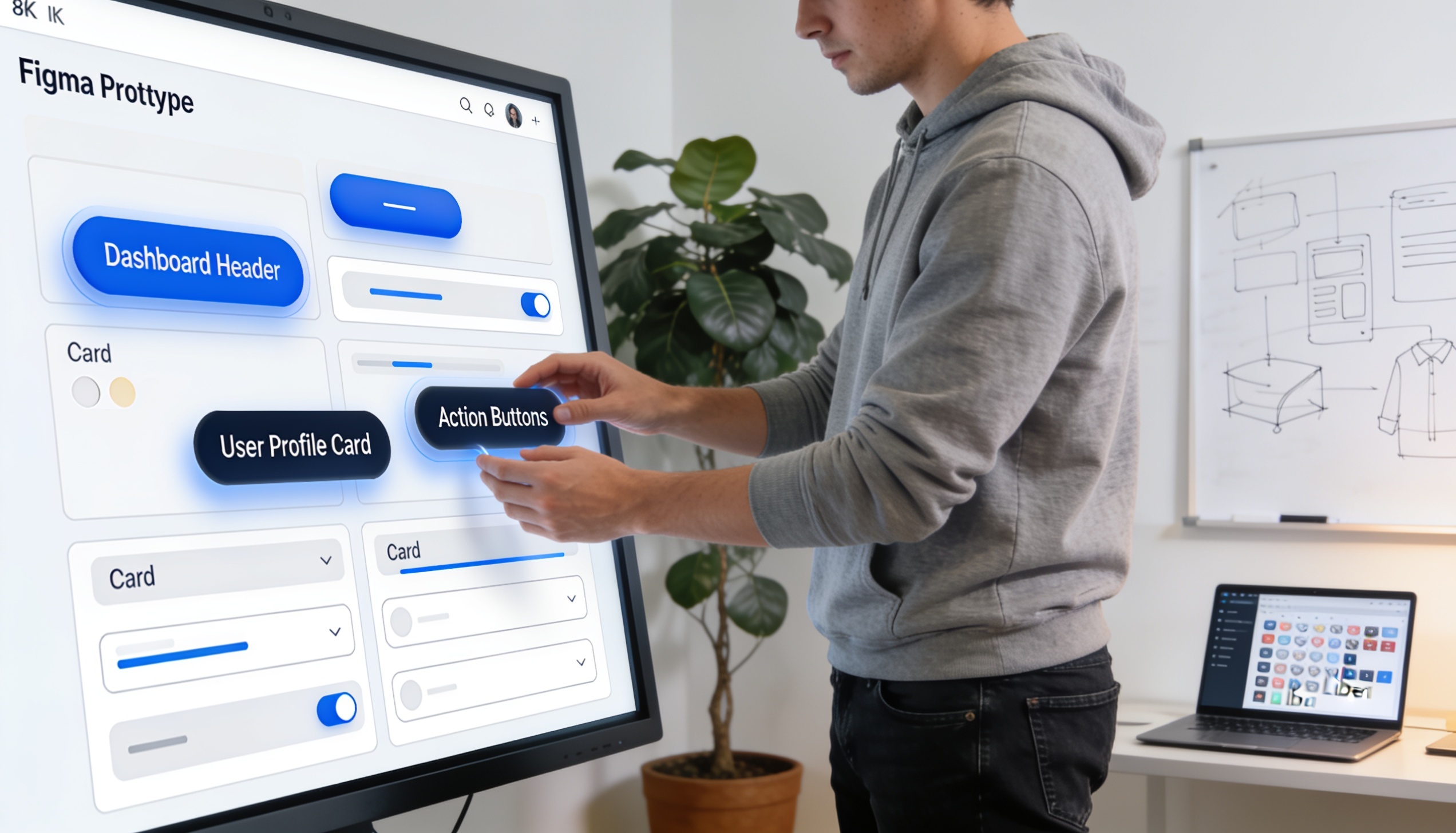
Most web design projects involve some copywriting. Homepage headlines, feature section copy, call-to-action text, UI microcopy — this work takes time and often defaults to the designer when there is no dedicated copywriter on the project.
Claude is the most reliable AI for producing clean, non-generic website copy. Give it the brand tone, the audience description, the page goal, and three to five example phrases that sound right — it will hold that voice across an entire page without drifting into generic marketing language. The 200,000-token context window means your existing site copy, brand guidelines, and brief can all sit in one conversation without the tool losing track of earlier context. The free plan is sufficient for one to two pages per day; Claude Pro at $20/month removes those limits. For reference, Anthropic's usage guide covers what the free tier includes before you commit to Pro.
ChatGPT is a practical alternative if you are also generating image concepts and social content in the same workflow — its DALL-E 3 integration keeps everything in one interface. ChatGPT memory also retains client context across sessions, so brand tone and audience details do not need re-entering each time you open a new conversation. The free plan includes GPT-4o with web browsing — useful when you need to check competitor copy or pull current product details without leaving the chat.
For copy that goes directly to a client, run the output through Grammarly before delivery. Even clean AI copy benefits from a grammar and style pass before it carries a client's name. Grammarly Pro at $12/month flags passive voice, awkward phrasing, and tonal inconsistencies that AI tools produce without flagging themselves. For client deliverables, the extra check costs less than one hour of revision time if the copy lands wrong.


What AI tools cannot do — and when to stop
AI tools remove the slow parts of web design work. They do not remove the judgment parts. The distinction matters when deciding what to offload and what to keep.
AI image generation — Canva Dream Lab, Midjourney, DALL-E 3 — produces training-data composites, not original art. For brand-defining imagery that needs to carry a client's identity, illustration, or product photography, the output is rarely good enough without significant direction and curation. Use AI for mood board exploration and asset backgrounds, not for hero images on a brand's homepage where the visual has to be distinctly theirs.
AI copy tools produce statistically probable text. That means it sounds reasonable but says what everything else says. Homepage copy that competes in a specific market needs a point of view the tool does not have — it does not know the client's actual differentiator, the customer objections that kill conversion, or the specific word choices that resonate with this audience versus the generic one. AI gives you a fast first draft. The designer or copywriter adds the part that makes it work.
Prototyping tools like Lovable and Bolt generate functional code, but they do not enforce design system consistency, handle edge cases in complex user flows, or ensure accessibility compliance at production level. For client handoffs where the code needs to meet specific standards — WCAG 2.1 AA, specific browser support, performance budgets — verify the output rather than assuming it meets the bar.
Where AI tools genuinely earn their cost is the work that is well-defined and repetitive: resizing assets to ten platform formats, generating five headline variants, producing first-draft copy for thirty product descriptions, converting an existing design to a live URL for client review. High volume, low ambiguity, no brand-defining judgment required. Those tasks are the right ones to hand to AI.
Ready to try Canva AI?
Free plan. Pro at $15/month.
Frequently Asked Questions
Continue reading


June 27, 2026