

Bolt
★4.3Website BuildersBuild and run web apps directly in your browser.
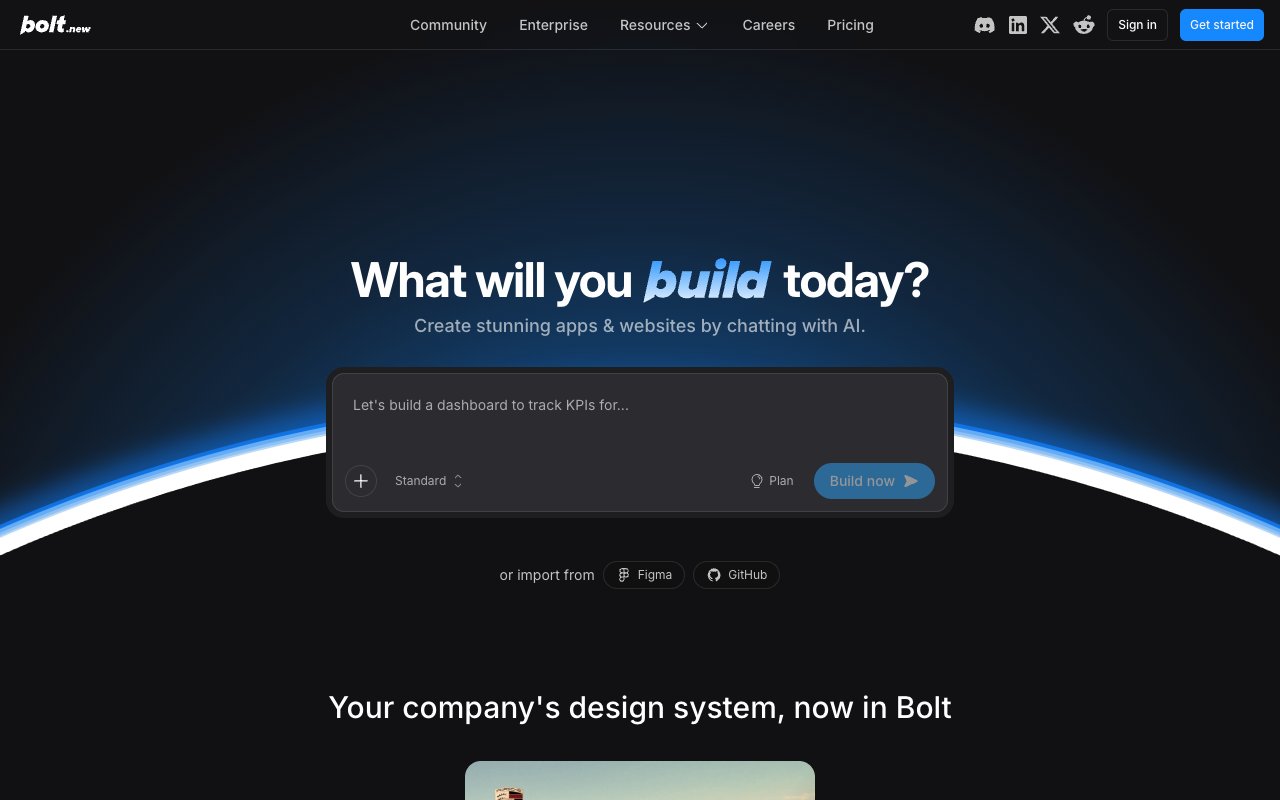
Bolt (bolt.new) by StackBlitz is a browser-based AI coding environment. You describe a project, Bolt generates the code and runs it in a live preview. It supports React, Next.js, Vue, and other frameworks. Best for quick prototypes and demos.
| Category | AI Website Builders |
| Pricing | Free plan (limited). Paid plans from $20/month. |
| Free plan | Yes |
| Best for | Quick prototypes, Landing pages, Demo apps, Beginners learning web development |

Affiliate link — we may earn a commission if you sign up, at no extra cost to you.
Pros and cons
+ What works
- Runs entirely in the browser — no local setup needed
- Supports multiple frameworks out of the box
- Fast for getting a working prototype running
- Good for sharing live demos via URL
− Worth knowing
- Less capable than Lovable for larger or database-backed apps
- Can struggle with complex multi-page applications
- Free tier runs out quickly
How Bolt works
Bolt runs entirely in your browser, powered by [StackBlitz](https://stackblitz.com)'s WebContainers technology — a system that runs a full Node.js environment in the browser without any local installation. You describe what you want to build, Bolt generates the code, and a live preview appears in the same window. You can share that preview URL with anyone. The full technical documentation for WebContainers is at [developer.stackblitz.com](https://developer.stackblitz.com/docs/platform/webcontainers/).
Supported frameworks include React, Next.js, Vue, Svelte, and Astro. Bolt can scaffold a new project from scratch or work with an existing GitHub repository. The workflow is genuinely fast — for simple projects, you can have something running in under five minutes.
WebContainer executes Node.js via WebAssembly — there is no virtual machine and no backend server spun up per user. This keeps startup instant and requires no network round-trip to an external runtime. The tradeoff is npm package compatibility: pure JavaScript packages install without issue, but packages that rely on native binaries — such as sharp for image processing or sqlite3 for database access — are not supported. Bolt surfaces an error when you try to install one and suggests a JavaScript-native alternative where it can.
Each session operates within a context budget. For straightforward projects this is rarely a problem. For longer build sessions that span many prompts and file edits, the budget can run out — at which point you either start a new thread or manually summarise what was built and paste it as a fresh starting prompt. Iterative prompting is how most productive Bolt sessions work: after the initial build, you type changes like "make the nav sticky" or "add email validation to the contact form," and Bolt applies a targeted diff to the existing files rather than regenerating the project from scratch.
What Bolt handles well
Bolt excels at single-page apps, dashboards with static data, landing pages, and demo builds. If you need to show a client what a UI could look like, Bolt is the fastest way to get there. If you are learning a new framework and want to see how components fit together, the live preview makes the feedback loop tight.
For developers who already know how to code, Bolt is most useful as a scaffolding tool — generate the boilerplate, then take the exported code and build from there. The generated code is readable and maintainable, which is not always the case with AI-generated codebases.
Framework selection is either explicit or natural language. You can open the framework picker and choose React, Vue, Angular, Astro, Svelte, Remix, or Next.js directly, or describe your project and Bolt infers the right choice. Each framework is pre-wired with Tailwind CSS by default, so the visual output looks clean without any configuration on your part.
Bolt ships with a set of starter templates — a blank canvas, a portfolio page, a SaaS landing page, a to-do app, and an API explorer, among others. These are not static HTML exports. They are fully runnable development environments: component-level code with typed props, hot reload, and a live preview URL you can hand to a client on the spot. A SaaS landing page template comes with a pricing section component, a feature grid, and a hero block — all editable through further prompts.
Deployment is handled from within the Bolt interface. A one-click push to Netlify is available without leaving the editor. If you prefer to manage your own deploy pipeline, GitHub export is also available and the resulting repository is clean enough to drop into any CI/CD setup.
Where Bolt falls short
Bolt's significant limitation is backend support. It does not have [Lovable](/tools/lovable)'s Supabase integration. Building anything that requires real user authentication, persistent data storage, or server-side logic requires manual work after Bolt generates the frontend.
The free tier runs out quickly if you are iterating heavily. Each generation uses credits, and a back-and-forth build session can consume a day's worth in an hour.
And for large or complex applications — multi-page apps with many components and data relationships — Bolt's context management can break down. It loses track of what was built earlier and starts generating code that conflicts with what already exists.
Pricing
Bolt's free plan gives daily credits that reset each day. It is generous enough for casual experimentation but not for a focused build session. Paid plans start at $20/month and scale by usage.
Compared to Lovable (also $20/month starting), Bolt's paid plan has a more flexible credit model but less backend capability. The choice between [Lovable](/tools/lovable) or Bolt is not really about price — it is about whether your project needs a database. The practical test: if you hit the free credit limit before finishing your evaluation, the $20/month paid plan is worth one month to determine whether Bolt handles your specific use case before you commit long term.
Who should use Lovable instead
If your app needs users to create accounts, if it stores any data that needs to persist between sessions, or if multiple users need to interact with the same data — use Lovable, not Bolt. Bolt will get you a prototype that looks right but does not actually work as a real application.
If you are a non-developer building something you intend to launch publicly, the same applies. Bolt's output is a great starting point, but turning it into a production-ready application without coding knowledge requires more work than most people anticipate. If your app needs user accounts or persistent data, start with [Lovable](/tools/lovable) instead.
Teams who need custom backend logic will hit a wall quickly. Bolt has no built-in database, no authentication layer, and no server functions. Connecting Supabase or Firebase is possible, but requires leaving the Bolt environment and writing the integration code manually — at which point the browser-based setup stops providing much value.
Native mobile app development is out of scope. Bolt outputs web applications only. React Native and Flutter projects cannot be built or previewed inside Bolt. A responsive web app can be opened in a mobile browser, but that is not the same as a native application with access to device hardware or app-store distribution.
Large-scale production applications with many modules, complex state, and deep data relationships hit the per-session context ceiling before the project is complete. Once the budget runs out, the model loses track of earlier decisions and generates code that conflicts with what already exists — a problem that compounds with more prompting rather than resolving.
Developers who prefer full control of their stack will also find Bolt's defaults constraining. The built-in deployment path runs through Netlify. If your team uses a different hosting provider or has an established CI/CD pipeline, that integration is not available out of the box. For those cases, [Cursor](/tools/cursor) paired with your own tooling is a better fit.
Our verdict
Bolt
★4.3Bolt (bolt.new) by StackBlitz is a browser-based AI coding environment. You describe a project, Bolt generates the code and runs it in a live preview. It supports React, Next.js, Vue, and other frameworks. Best for quick prototypes and demos.
Best for
Quick prototypes, Landing pages
Pricing
Free plan (limited). Paid plans from $20/month.
Frequently Asked Questions
Bolt compared to alternatives

Tovorify Editorial
Who reviews these tools →