

Cursor
★4.7Coding ToolsThe AI code editor built for professional developers.
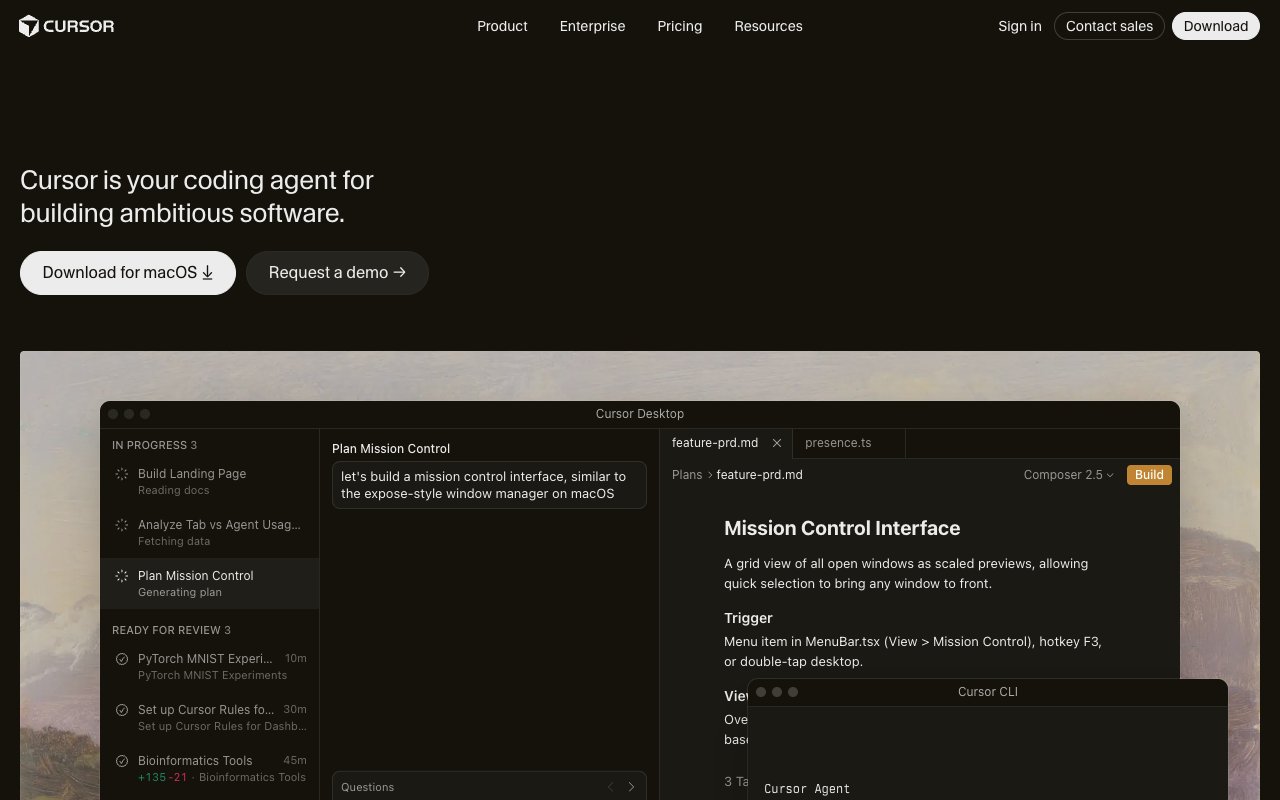
Cursor is a VS Code fork with deep AI integration. It understands your entire codebase, can edit multiple files at once, and lets you chat with your code in context. Used by professional developers and engineering teams worldwide.
| Category | AI Coding Tools |
| Pricing | Free plan (limited). Pro at $20/month. |
| Free plan | Yes |
| Best for | Professional software development, Large codebase navigation, Multi-file refactoring, Code review and debugging |

Affiliate link — we may earn a commission if you sign up, at no extra cost to you.
Pros and cons
+ What works
- Deep understanding of your full codebase
- Multi-file editing and refactoring
- Familiar VS Code interface — no learning curve for existing users
- Supports all major AI models including Claude and GPT-4o
− Worth knowing
- Requires existing coding knowledge to use effectively
- Can be slow on very large codebases
- Pro plan is required for serious daily use
How Cursor works
Cursor is a fork of VS Code — the most widely used code editor in the world. If you already use VS Code, switching to Cursor has essentially zero learning curve. All your extensions, keybindings, and settings carry over. The difference is that every part of the editor has been rebuilt around AI.
The main AI features: Tab completes your code before you finish typing (more capable than Copilot's suggestions), Cmd+K edits selected code inline based on a natural language instruction, and the Chat panel answers questions about your codebase with full context of the files you have open. The standout feature is Composer — a multi-file editing mode where you describe a change and Cursor edits every affected file at once.
Tab and Composer do very different things. Tab completion predicts your next line based on what you have already typed — it is reactive and fast. Composer is intent-driven: you describe a change in plain language, Cursor generates a diff across every affected file in the project, and you review and accept or reject changes file by file. Tab is for flow; Composer is for intent.
The Chat sidebar works on any file without leaving the editor. Three commands make it precise: @file scopes a question to a specific file, @symbol jumps directly to a named function or class, and @docs points Cursor at any external documentation URL — it fetches the docs and incorporates them into context for library-specific questions. Model choice is per-request: switch between Claude Sonnet, GPT-4o, and o3-mini before sending, depending on whether you need quality, speed, or cost.
Codebase indexing
What makes Cursor different from GitHub Copilot is codebase indexing. Cursor builds a semantic map of your entire project — not just the file you have open. When you ask "where is the authentication logic?" or "add error handling to every API call", Cursor knows where everything is without you having to navigate to it.
On a 10,000-line project, this is useful but not essential. On a 200,000-line production codebase, it is the reason engineers at companies like Stripe, Vercel, and Linear have adopted Cursor as their primary editor. The [Cursor documentation](https://docs.cursor.com/) explains how to configure codebase indexing for large repositories. The AI understands the project well enough to make changes that do not break things elsewhere.
Two features extend indexing in practice. The .cursorrules file lives at the repo root — a plain text file where you write permanent instructions Cursor follows on every request: "always use async/await, never callbacks" or "this project uses TypeScript strict mode." You write it once; Cursor applies it every session without repeating yourself in chat. The @codebase command tells Cursor to search the entire indexed repo before answering, rather than relying only on open files — useful for "where is X defined?" questions that span multiple packages.
The @docs command complements this: point it at any documentation URL and Cursor fetches and incorporates those docs into context for library-specific questions. Indexing handles up to around 200,000 files. Beyond that, .cursorignore configuration — which works like .gitignore — keeps performance reasonable by excluding generated files and large dependency directories.
Models and pricing
Cursor Pro costs $20/month. The free plan gives 2,000 Tab completions and 50 slow premium requests per month — slow requests use a smaller model with longer latency, enough to evaluate the product for a week or two. Full pricing details at [cursor.com/pricing](https://www.cursor.com/pricing).
On Pro, you get 500 fast requests per month plus unlimited slow requests. Fast requests use full Claude Sonnet or GPT-4o capacity — noticeably quicker and more capable than the slow tier. Most users leave the model selector on Claude 3.5 Sonnet for general coding. o1 is useful for hard algorithmic problems where you want the model to think longer; o3-mini is available for faster, cheaper responses on routine tasks.
The credit system is worth understanding before you hit limits. Each fast Composer session uses 1 credit regardless of how many files it edits — a session that touches 20 files costs the same as one that touches 2. Chat messages use 0.5 credits each. Tab completions do not draw from the fast request pool at all and are unlimited on Pro.
Business is $40/seat/month. It adds an admin dashboard, SSO, usage analytics per seat, and the ability to enforce a shared .cursorrules file across the entire team — so every developer follows the same AI instructions without needing to configure their own. For teams where consistency and auditability matter, Business is the practical option.
Who Cursor is for
Cursor is for professional developers — people who write code for a living and want AI integrated deeply into their workflow rather than bolted on as an afterthought.
It is particularly well-suited to: engineers working on large codebases who need the AI to understand the full project context, teams doing significant refactoring or migrating between frameworks, and developers who already use VS Code and want to upgrade without changing their environment. Teams already using [GitHub Copilot](/tools/github-copilot) as a plugin often switch to Cursor when they need deeper codebase understanding than a plugin model can provide.
Who should not use Cursor
Cursor is not a no-code tool. The AI generates code that you need to understand, review, and sometimes fix. If you do not know what a React component is or what a SQL query does, Cursor will not help you — it will generate code you cannot evaluate, and you will not know when it is wrong.
For non-developers who want to build something, [Lovable](/tools/lovable) is the more appropriate starting point. For developers who primarily work in JetBrains IDEs, note that neither Cursor nor [Windsurf](/tools/windsurf) (now Devin Desktop) offers a JetBrains plugin — both are standalone VS Code forks. [GitHub Copilot](/tools/github-copilot) remains the practical AI option inside JetBrains.
Our verdict
Cursor
★4.7Cursor is a VS Code fork with deep AI integration. It understands your entire codebase, can edit multiple files at once, and lets you chat with your code in context. Used by professional developers and engineering teams worldwide.
Best for
Professional software development, Large codebase navigation
Pricing
Free plan (limited). Pro at $20/month.
Frequently Asked Questions
Cursor compared to alternatives

Tovorify Editorial
Who reviews these tools →