

Windsurf
★4.3Coding ToolsNow Devin Desktop — Cognition's agent-first AI code editor.
Windsurf was rebranded to Devin Desktop in June 2026 after Cognition — the company behind the Devin coding agent — acquired it. It is still a VS Code fork that competes directly with Cursor, but the product now centers on dispatching autonomous agents: Devin Local on your machine, cloud sessions for background work.
| Category | AI Coding Tools |
| Pricing | Free plan with daily quota. Pro at $20/month. |
| Free plan | Yes |
| Best for | Developers who want an agent-first workflow, Teams already using Devin cloud agents, Students (roughly 50% off Pro) |

Affiliate link — we may earn a commission if you sign up, at no extra cost to you.
Pros and cons
+ What works
- Devin Local runs multi-step tasks with subagents working in parallel
- Unlimited Tab autocomplete on every plan, including Free
- Local and cloud agents managed from one Agent Command Center
- One of the better student discounts in the category (~50% off Pro)
− Worth knowing
- Mid-transition: Cascade retired in July 2026, workflows need re-learning
- Smaller community than Cursor
- Still behind Cursor on codebase indexing for very large repos
How Windsurf became Devin Desktop
Windsurf changed hands twice in one week of July 2025: Google paid $2.4 billion to bring the founders and research leads into DeepMind, and days later [Cognition](https://cognition.ai) — the company behind the Devin coding agent — acquired the product, brand, and remaining team. On June 2, 2026, Cognition renamed the editor [Devin Desktop](https://devin.ai/blog/windsurf-is-now-devin-desktop). Existing installs updated automatically.
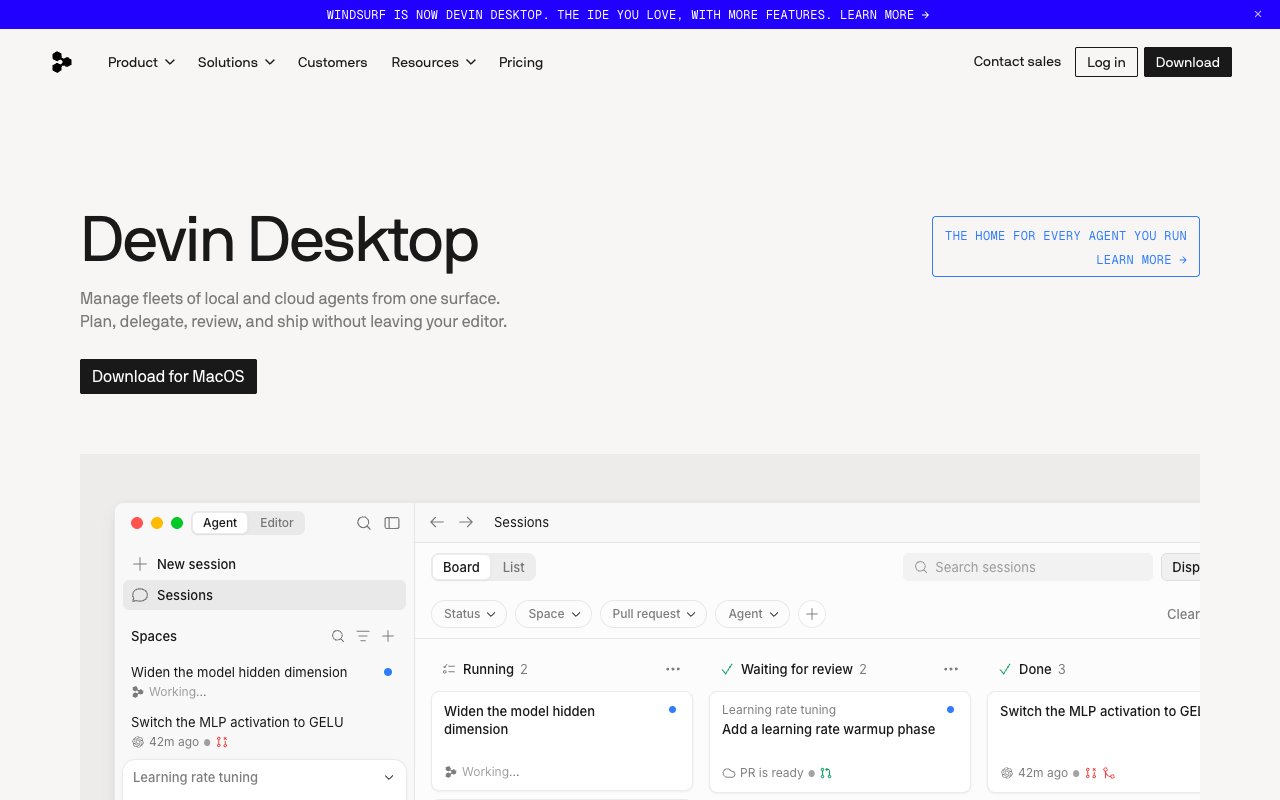
Underneath, it is still a VS Code fork like [Cursor](/tools/cursor) — same interface family, same extension support, same keybindings. What changed is the center of the product. Devin Desktop opens on an Agent Command Center: a board for dispatching and monitoring agents, local and cloud, rather than an editor canvas.
Devin Local is the on-machine agent that replaced Cascade in July 2026. It runs multi-step tasks — read the error, edit the file, re-run the test — and can spawn subagents to work parts of a task in parallel. Cloud sessions handle longer background work: you describe a goal, an agent works on it remotely, and the result comes back for review.
Tab, the inline autocomplete, is still there and is unlimited on every plan. For developers who use completion heavily and agents occasionally, that alone makes the free tier worth having installed.
Devin Local in practice
Devin Local is the reason to evaluate Devin Desktop rather than defaulting to Cursor. It runs a read-plan-act-verify cycle for each step: read the affected file, plan the change, apply it, check terminal output or test results, then decide the next action — without waiting for your approval between steps. On a mid-sized project, a refactor that would take twenty manual prompts in a reactive tool finishes in a handful of dispatched tasks.
The subagent model is the practical upgrade over the old Cascade: a task like "migrate all API calls to React Query" fans out across files in parallel instead of working through them one at a time. The tradeoff is the same as it always was — speed against transparency. You see fewer confirmation checkpoints, so trust builds task by task.
If you were a Windsurf user with workflows tuned for Cascade, budget a few days of re-learning. Cascade reached end of life on July 1, 2026; the concepts carry over, but the interface now runs through the Agent Command Center.
Devin Desktop vs Cursor on price
Both Pro plans are $20/month. Windsurf's old $15 price ended in March 2026, when the credit system was replaced with daily and weekly quotas and the price moved to $20 — if you saw "Windsurf is the cheaper Cursor" advice, it is out of date.
The free plan has a daily quota for agent and chat use, but Tab autocomplete is unlimited on every plan and never consumes quota. That makes the free tier genuinely usable as a completion-only editor, with agents available for occasional tasks.
Model choice affects quota consumption: Devin's own SWE models draw down the allowance at a fixed per-message rate, while Claude and GPT models consume proportionally to tokens processed. Heavy agent users on big tasks burn quota noticeably faster on the frontier models.
Students get roughly 50% off Pro with a verified .edu address — one of the better student discounts in the AI coding category. For the head-to-head against Cursor, see the [Cursor vs Windsurf comparison](/compare/cursor-vs-windsurf).
Who Windsurf is for
Devin Desktop makes most sense for three groups: developers who want an agent-first workflow, where you describe tasks and review results rather than steering every edit; teams already using Devin's cloud agents, since local and cloud work now live in one product; and developers currently on [GitHub Copilot](/tools/github-copilot) who want real agent capabilities without paying for two tools.
The best fit is solo developers who want autonomous code execution without constant approval prompts, and teams where wide-reaching multi-file changes are the primary task. Devin Local's subagents handle the kind of refactor that touches a dozen files across multiple directories with far less manual prompting than a reactive tool.
Language support covers Python, JavaScript, TypeScript, Go, Rust, Java, C++, and Ruby — the same breadth as Cursor. Worth noting: Devin Desktop is a standalone editor, not a plugin, so developers tied to JetBrains IDEs cannot use it without switching editors entirely.
Students are a specific good fit: roughly half off Pro with a .edu address, plus unlimited free Tab autocomplete for the completion-only days.
When to choose Cursor instead
[Cursor](/tools/cursor) is the better choice for large production codebases. Its indexing is more mature, its multi-file editing is more reliable, and its community is larger — which means more documented workflows and more third-party integrations. Both cost $20/month now, so the decision is purely about workflow.
Developers who prefer explicit control over every AI action will find the agent-first model frustrating. Devin Local acts autonomously between prompts — it runs tests, edits files, and takes next steps without asking. If you prefer accepting or rejecting each suggestion line by line, Cursor's workflow is closer to that.
There is also a timing consideration: the product is mid-transition. Cascade retired in July 2026, Devin Local is new, and documentation and community answers are still catching up to the rename. If you need a tool that is stable this quarter, Cursor is the safer pick; revisit Devin Desktop once the dust settles.
JetBrains users have no path to Devin Desktop without switching editors entirely — no plugin exists as of mid-2026.
Our verdict
Windsurf
★4.3Windsurf was rebranded to Devin Desktop in June 2026 after Cognition — the company behind the Devin coding agent — acquired it. It is still a VS Code fork that competes directly with Cursor, but the product now centers on dispatching autonomous agents: Devin Local on your machine, cloud sessions for background work.
Best for
Developers who want an agent-first workflow, Teams already using Devin cloud agents
Pricing
Free plan with daily quota. Pro at $20/month.
Frequently Asked Questions
Windsurf compared to alternatives

Tovorify Editorial
Who reviews these tools →