

Lovable
4.6/5Website BuildersBuild real web apps by describing what you want.
Lovable generates full-stack web applications from plain English descriptions. You describe the app you want, Lovable writes the code and hosts it at a live URL. Its built-in backend, Lovable Cloud, adds a database, authentication, file storage, realtime updates, and functions by default.
Tovorify score
Highly Rated
#1 in Website Builders
| Category | AI Website Builders |
| Pricing | Free plan (5 credits/day, up to 30/month). Pro at $25/month. Business at $50/month. |
| Free plan | Yes |
| Best for | Building web apps without code, SaaS prototypes, Internal tools, Portfolio sites |
Plans at a glance
USD per month
- Free$0
- Pro$25
- Business$50
Pros and cons
What works
- Generates working full-stack apps, not just mockups
- Hosts your app at a live URL automatically
- Lovable Cloud backend: database, auth, storage, realtime, and functions
- Unlimited users on every plan, with GitHub sync for your code
Worth knowing
- Free plan is small: 5 credits a day, up to 30 a month
- Complex apps can hit context limits and burn credits quickly
- Less control than writing code yourself
How Lovable works
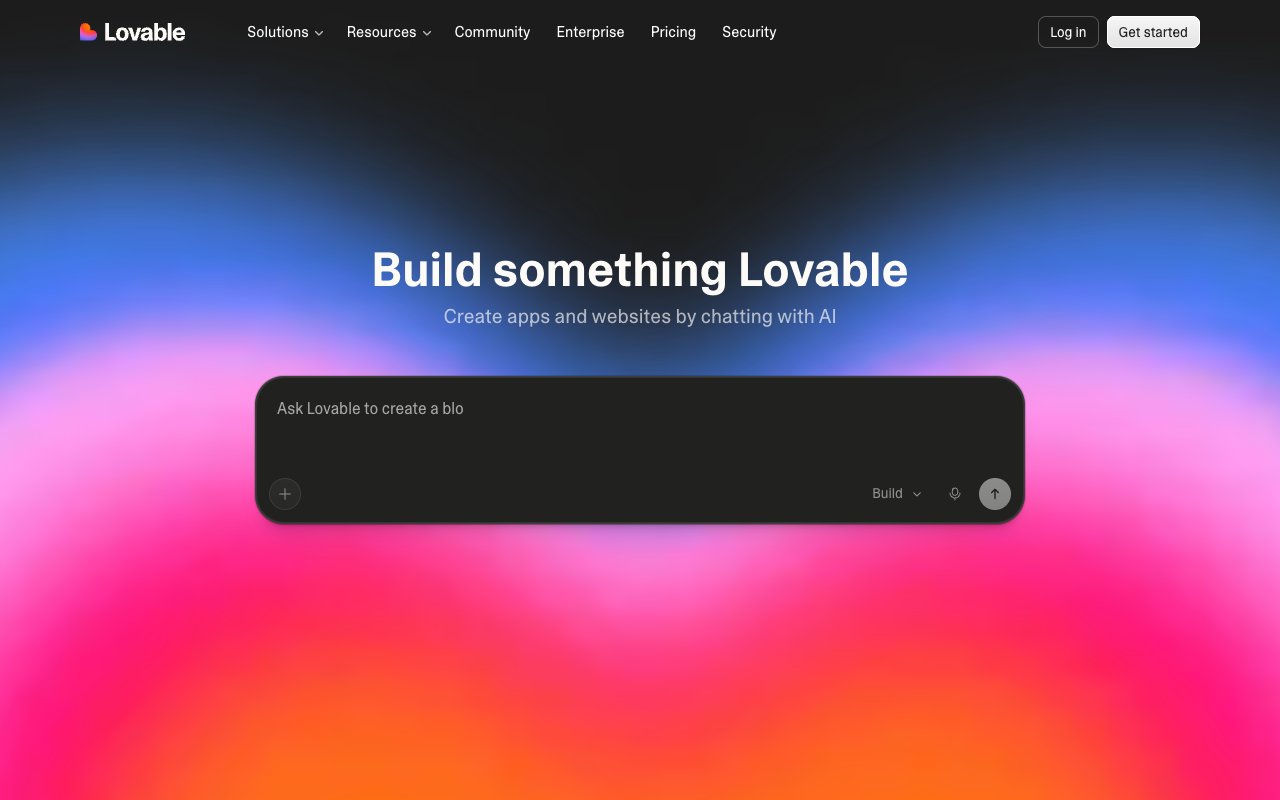
You describe the app you want in plain English. Lovable generates the React code, sets up the file structure, and deploys it to a live URL — usually within two to three minutes. You can then iterate by describing changes in the same way: "add a login page", "make the sidebar collapsible", "connect this form to the database".
The underlying code is real React — not a proprietary format, not a locked-down platform. You can export it at any time and host it yourself, hand it to a developer to maintain, or use it as the starting point for a more complex build. This matters because it means you are not locked in.
Every project generates React with TypeScript and Tailwind CSS by default — there is no framework picker and no option to output bare HTML. If you need a different stack, Lovable is not the right tool. Starting from scratch is faster with Lovable's template gallery, which includes SaaS dashboards, landing pages, e-commerce storefronts, and admin panels — select one and describe what to change rather than building from an empty canvas.
The editing loop uses a split-panel interface: your prompt goes on the left, a live working preview renders on the right. Changes are diff-based rather than full regeneration — Lovable updates only the parts of the code affected by your prompt, which keeps the session fast. Each project syncs automatically to a GitHub repository. You can pull the repo, open it in Cursor or any other editor, and commit changes directly — Lovable will pick them up when you return to its interface.
Lovable Cloud: the built-in backend
Lovable's most significant technical feature is its built-in backend. Lovable's documentation describes Lovable Cloud as a managed PostgreSQL database with storage, authentication, realtime updates, and functions, built on Supabase's open-source foundation and enabled by default.
When you tell Lovable "add user accounts" or "store this form data", it sets up the tables, access rules, and sign-in flows for you. The result is not a mock database or local storage hack — it is a real database that persists data and handles multiple users.
Sign-in is broad: Lovable documents email, phone, Google, Apple, Microsoft, SAML SSO, and OIDC options. Realtime updates push new data to connected users without a page refresh, which is useful for chat apps, live dashboards, or anything several people edit at once. Functions let the app run server-side logic, such as calling a third-party API with a secret key, without you setting up a separate server.
The gap with other AI builders has narrowed. Bolt now includes databases and hosting too, even on its free plan. Lovable's edge is that the backend is set up by default and covers authentication and functions in one place, so a non-technical founder can get to a working app with user accounts with fewer decisions. For complex business logic, still plan for a developer to review what was generated before real users rely on it.
Pricing
Lovable meters usage in credits. As listed on Lovable's pricing page:
**Free:** 5 credits a day, up to 30 a month. Enough to prototype a simple concept, not enough for a real project with back-and-forth iteration.
**Pro:** $25 a month for 100 monthly credits on top of the free grants, with credit rollovers, on-demand top-ups, custom domains, and removal of the Lovable badge.
**Business:** $50 a month, adding SSO, a team workspace, and role-based access.
All plans allow unlimited users, so a founder and a developer can work in the same project without paying per seat.
How far 100 credits go depends on how you prompt. Small, specific requests ("make the sidebar collapsible") use fewer credits than broad ones ("redesign the dashboard"), and fixing errors also costs credits. The is Lovable worth it breakdown goes deeper on how credits get used.
Compared with hiring even a junior developer for a few hours, $25 a month is cheap. The comparison that matters is whether Lovable can actually build what you need — the price is rarely the deciding factor.
Lovable vs Bolt
Bolt is the tool most people compare Lovable with, and the two have converged: both build full-stack web apps from plain-English prompts, and both include databases and hosting on their free plans.
The differences are in metering and defaults. Lovable meters work in credits — 5 a day on the free plan, up to 30 a month, and 100 a month on Pro. Bolt meters AI tokens — 1M a month on its free plan with a 300K daily limit, and 10M a month on Pro. In practice Bolt's free plan goes further for trying ideas, and Bolt Pro is cheaper on yearly billing ($18 a month against Lovable's $25).
Lovable's advantage is the backend that is set up by default: database, authentication with many sign-in options, storage, realtime, and functions in one place, plus unlimited users on every plan. Bolt gives you more choice instead, including the database provider on Pro, and charges per member on Teams ($30, or $27 billed yearly).
A practical test: build the same small idea on both free plans in one afternoon. If you need user accounts and stored data with as few decisions as possible, Lovable usually gets there first. If you want to iterate quickly and cheaply on a prototype, Bolt's larger free allowance often wins. The Lovable vs Bolt comparison covers the details.
Who Lovable is for
Lovable is for non-technical founders, solo operators, and small teams who have a product idea and need something functional — not just a mockup, not a landing page, but an actual working application.
Specific use cases that work well: SaaS tools with user accounts, internal dashboards for small teams, customer-facing forms and data collection tools, simple marketplaces. The common thread is that these are apps with real backend requirements that would otherwise need a developer to build. If your MVP requires users to sign in and store data, Lovable's built-in backend gets you there with very few setup decisions.
Lovable is also a practical starting point for technical co-founders who want something testable before committing to a custom build — the React code Lovable exports is readable and clean enough to hand to a developer when the project outgrows the platform.
Who should not use Lovable
If you just need a marketing website or landing page, Lovable is the wrong tool. Webflow, Framer, or a static site generator will be faster, cheaper, and produce a better result for a content site.
If you are an experienced developer, Lovable's generated code will frustrate you. It makes architectural choices that a senior engineer would not make, and the code is not always easy to extend. In that case, use Cursor and write the code yourself.
And if your app has complex business logic, unusual data relationships, or needs to scale to thousands of concurrent users, you will likely need a developer to take over the exported code before you finish building.
Our verdict
Lovable
4.6/5Lovable generates full-stack web applications from plain English descriptions. You describe the app you want, Lovable writes the code and hosts it at a live URL. Its built-in backend, Lovable Cloud, adds a database, authentication, file storage, realtime updates, and functions by default.
Best for
Building web apps without code, SaaS prototypes
Pricing
Free plan (5 credits/day, up to 30/month). Pro at $25/month. Business at $50/month.
Frequently Asked Questions
Articles about Lovable
Lovable compared to alternatives

Founder, Tovorify — reviews every tool on this site