

Gemini
★4.3Google's AI assistant, built into Search, Docs, and Gmail.
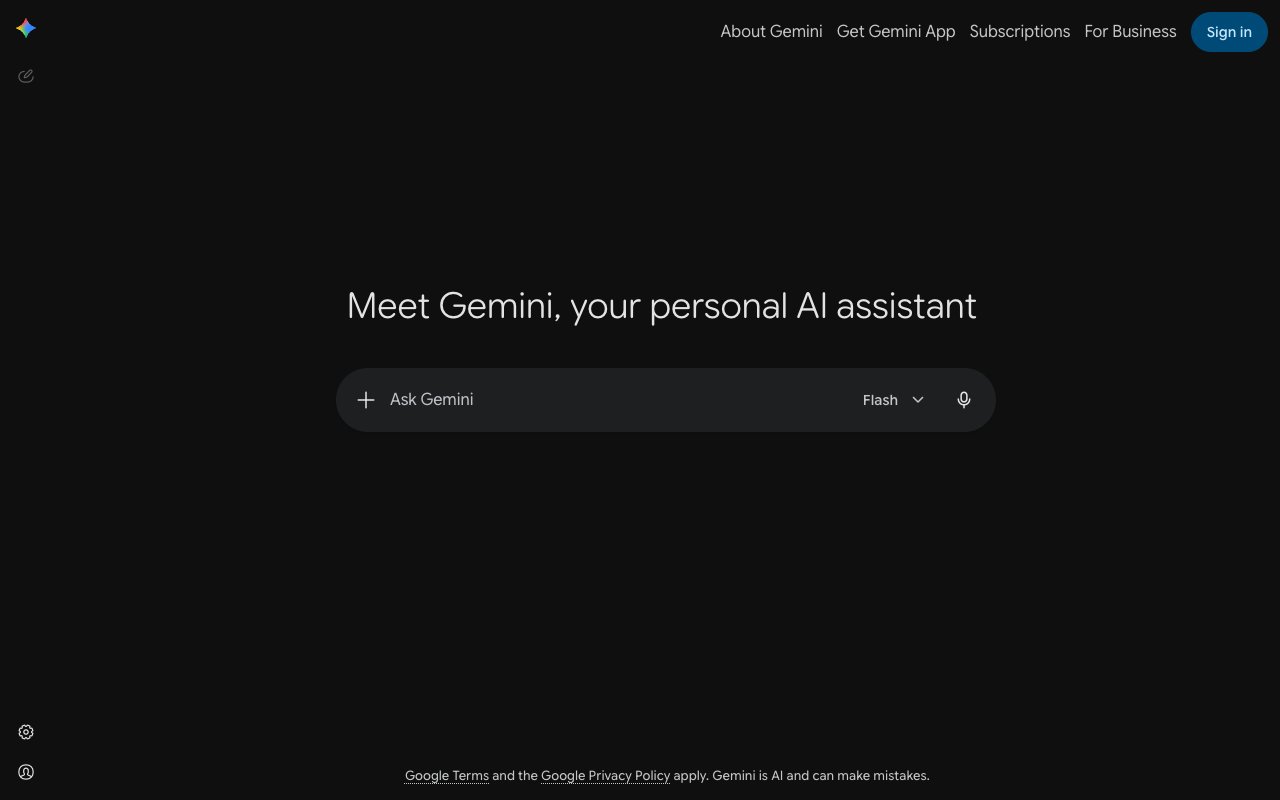
Gemini is Google's AI assistant, available as a standalone product and embedded across Google Workspace — Docs, Sheets, Gmail, Slides, and Drive. The Advanced tier runs on Gemini Ultra, Google's most capable model. Gemini has a 1 million token context window, native multimodal input, and Google Search grounding that gives it access to current information by default.
| Category | AI Assistants |
| Pricing | Free plan (Gemini 1.5 Flash). Gemini Advanced at $19.99/month (included in Google One AI Premium). Google Workspace add-on pricing varies by plan. |
| Free plan | Yes |
| Best for | Google Workspace users, Research with real-time web access, Multimodal tasks (text + image + audio), Summarising long documents and emails, Teams already on Google One or Workspace plans |

Affiliate link — we may earn a commission if you sign up, at no extra cost to you.
Pros and cons
+ What works
- Integrated across Google Workspace — Docs, Gmail, Sheets, Slides
- 1 million token context window on Advanced tier
- Real-time Google Search access on all tiers by default
- Native multimodal: handles text, images, audio, and video in one conversation
− Worth knowing
- Gemini Advanced is $19.99/month vs ChatGPT Plus at $20/month — similar price for less ecosystem depth
- Writing quality trails Claude on nuanced long-form tasks
- Workspace integration requires a paid Google One or Workspace subscription
- Model lags OpenAI and Anthropic on coding benchmarks
What Gemini does
Gemini is Google's AI assistant. The free version runs on Gemini 1.5 Flash — a fast, capable model that handles most everyday tasks: drafting emails, summarising documents, answering questions, and generating images via Imagen. Gemini Advanced runs on Gemini Ultra, Google's flagship model, and is included in the Google One AI Premium plan at $19.99/month.
The clearest practical difference from [Claude](/tools/claude) and [ChatGPT](/tools/chatgpt) is that Gemini has real-time Google Search access by default. You do not need to enable a web search mode — when you ask Gemini about current events, recent product releases, or up-to-date pricing, it pulls live results and cites sources. ChatGPT requires a web search toggle; Claude requires a Pro subscription and explicit search activation.
Gemini's context window on Advanced is 1 million tokens — roughly 750,000 words, or about 2,500 pages of text. This is substantially larger than [ChatGPT](/tools/chatgpt)'s 128,000-token window and [Claude](/tools/claude)'s 200,000-token window. For tasks that require analysing very long documents — an entire legal case file, a complete codebase, a book-length research corpus — Gemini Advanced can hold more in memory at once than any competitor at equivalent pricing.
The multimodal capability is genuinely native rather than bolted on. You can input text, images, audio, and video in the same conversation and Gemini processes all of them together. A practical use case: upload a screenshot of a dashboard, an audio recording of a meeting, and a written brief, and ask Gemini to produce a summary document that synthesises all three. That cross-modal reasoning is where Gemini outperforms narrower text-only tools.
Gemini in Google Workspace
The Google Workspace integration is Gemini's most distinctive practical advantage. If your team already uses Google Docs, Sheets, Gmail, and Drive, Gemini appears inside those tools without any additional setup. In Gmail, Gemini drafts replies, summarises long threads, and suggests responses. In Docs, it drafts content, rewrites sections, and suggests formatting. In Sheets, it generates formulas, builds summaries, and answers questions about the data.
The integration is tighter than what Microsoft Copilot achieves in Office 365 at equivalent price points. Gemini in Docs is genuinely contextually aware of the document you are editing — it can reference specific sections, maintain consistent terminology, and track changes across a long document without losing context. The same is true in Gmail, where Gemini accesses your actual email thread history to write replies that reference previous messages correctly.
Accessing Gemini in Workspace requires either the Google One AI Premium plan ($19.99/month) or a Google Workspace Business Plus or higher subscription. The feature is not available on free Google accounts or basic Workspace plans. For individuals already paying for Google One storage, the AI Premium upgrade adds Gemini Advanced and Workspace integration at the same price as [ChatGPT](/tools/chatgpt) Plus — which makes it the more natural choice for anyone whose work lives in Google's ecosystem.
For teams with mixed tool environments — some Google Workspace, some Microsoft — the integration advantage disappears. A team that uses Slack, Notion, and GitHub does not benefit from Gemini's Workspace integration and should evaluate it purely on model capability, where it competes closely with but does not clearly beat [Claude](/tools/claude) or [ChatGPT](/tools/chatgpt). See [Google's Workspace AI features overview](https://workspace.google.com/products/gmail/features/) for current feature availability.
Gemini vs ChatGPT
The comparison between Gemini and [ChatGPT](/tools/chatgpt) comes down to ecosystem. If you live in Google Workspace, Gemini integrates more naturally and costs the same at $19.99/month vs $20/month. If you use Microsoft Office, or if you want image generation and plugin support, [ChatGPT](/tools/chatgpt) has a larger ecosystem.
On raw model capability, the two are competitive on most tasks. Gemini Ultra (on the Advanced plan) and GPT-4o are both strong. ChatGPT has a larger plugin and GPT store ecosystem. Gemini has a meaningfully larger context window (1M tokens vs 128K) and better real-time information access.
For writing tasks — especially nuanced long-form writing — [Claude](/tools/claude) outperforms both. For coding, [ChatGPT](/tools/chatgpt) and Claude both rate above Gemini on most independent benchmarks. Gemini's strongest differentiation is the Workspace integration and the context window size. The [Claude vs ChatGPT comparison](/compare/claude-vs-chatgpt) is also relevant context if you are deciding between the three major AI assistants.
The 1 million token context window
Gemini Advanced's 1 million token context window is the largest available at standard consumer pricing. To put that in practical terms: 1 million tokens holds roughly 750,000 words — the equivalent of about 10 full-length novels, or a codebase with several hundred files loaded simultaneously.
For most everyday tasks, this size difference is irrelevant. A blog post, an email thread, or a standard document fits easily inside [ChatGPT](/tools/chatgpt)'s 128,000-token window or [Claude](/tools/claude)'s 200,000-token window. The 1 million token window matters in specific professional contexts: legal teams analysing very large case files, researchers working with book-length source material, engineers reviewing large codebases, or anyone who needs to maintain context across a very long ongoing project.
Google published research showing that Gemini 1.5 Pro retrieves specific information accurately from a 1 million token context with high recall rates, documented in [Google's Gemini 1.5 technical report](https://arxiv.org/abs/2403.05530). The practical implication is that you can load a large document and ask questions about specific sections without the model losing track of earlier content — a real limitation in models with smaller context windows when documents are very long.
For professionals who regularly hit context limits in [ChatGPT](/tools/chatgpt) or [Claude](/tools/claude), Gemini Advanced is the first practical solution at a price point comparable to competing paid plans.
Who should not use Gemini
Do not pay for Gemini Advanced if your team does not use Google Workspace. The $19.99/month price is justified by the Workspace integration — without it, you are paying the same as [ChatGPT](/tools/chatgpt) Plus for a product with a smaller plugin ecosystem and less community-developed tooling.
Avoid Gemini as your primary writing tool if you care deeply about prose quality. [Claude](/tools/claude) produces more considered, less generic long-form content. For blog posts, reports, and content where voice and style matter, the difference is noticeable.
It is not the right tool if you need a large library of integrations with third-party apps. ChatGPT's GPT store and plugin ecosystem is substantially larger than Gemini's current integration library. For workflows that connect AI to multiple external tools — Zapier automations, custom GPTs, Slack integrations — [ChatGPT](/tools/chatgpt) has more surface area.
And do not use Gemini free expecting the same capability as Advanced. Gemini 1.5 Flash (the free model) is meaningfully less capable than Gemini Ultra on the Advanced plan. The free tier is useful for light tasks, but if you are evaluating Gemini against a paid [ChatGPT](/tools/chatgpt) or [Claude](/tools/claude) subscription, compare Gemini Advanced, not the free version.
Our verdict
Gemini
★4.3Gemini is Google's AI assistant, available as a standalone product and embedded across Google Workspace — Docs, Sheets, Gmail, Slides, and Drive. The Advanced tier runs on Gemini Ultra, Google's most capable model. Gemini has a 1 million token context window, native multimodal input, and Google Search grounding that gives it access to current information by default.
Best for
Google Workspace users, Research with real-time web access
Pricing
Free plan (Gemini 1.5 Flash). Gemini Advanced at $19.99/month (included in Google One AI Premium). Google Workspace add-on pricing varies by plan.
Frequently Asked Questions
Gemini compared to alternatives

Tovorify Editorial
Who reviews these tools →