

CapCut
★4.2Video ToolsThe free video editor that dominates short-form content.
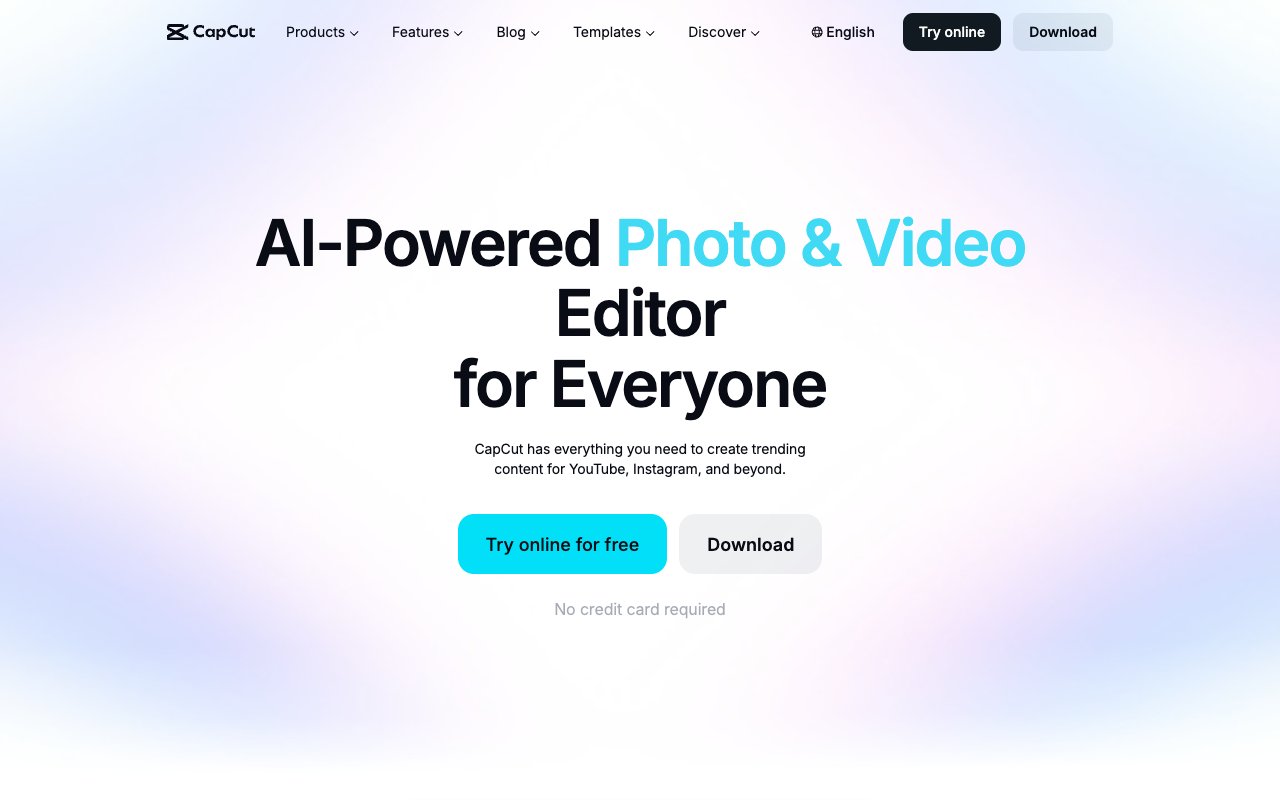
CapCut is a free video editing app by ByteDance with AI features built in — auto-captions, background removal, text-to-video, and one-tap templates. It is the most widely used short-form video editor in the world, with over 200 million monthly active users.
| Category | AI Video Tools |
| Pricing | Free plan. Pro at $9.99/month. Teams at $29.99/month. |
| Free plan | Yes |
| Best for | TikTok and Instagram Reels editing, Auto-captioning social videos, Quick background removal, One-tap AI templates for social content, Beginners editing video for the first time |

Affiliate link — we may earn a commission if you sign up, at no extra cost to you.
Pros and cons
+ What works
- Free plan includes most AI features — auto-captions, background removal, templates
- Over 200 million monthly users — largest template library of any mobile editor
- Available on mobile, desktop, and browser with synced projects
- Auto-caption accuracy is competitive with paid tools
− Worth knowing
- Owned by ByteDance — same parent company as TikTok, with associated data concerns
- Not suited for long-form or professional production work
- Watermark on free exports until Pro subscription
- Desktop app less mature than the mobile version
What CapCut does
CapCut is a video editing application made by ByteDance, the same company that owns TikTok. It is available on iOS, Android, desktop (Windows and Mac), and as a browser-based editor. Projects sync across devices. The free plan is genuinely usable — it includes AI auto-captions, background removal, a library of templates, and basic editing tools without a paid subscription.
The core editing workflow is timeline-based but simplified for short-form content. You import clips, trim and arrange them on the timeline, add music, captions, and transitions, and export. For experienced video editors, the interface is limited. For someone editing their first video or producing social content at speed, it removes most of the friction.
CapCut's AI features have expanded significantly in 2025. Text-to-video lets you type a script and generate a video from stock footage with auto-matched clips and captions. AI-generated avatars let you produce talking-head videos without filming. Auto-reframe resizes a landscape video to portrait (9:16) for social, tracking the main subject. These are the kinds of features that would have required separate specialist tools a year ago.
The Pro plan at $9.99/month removes the watermark from exports and adds higher-resolution exports, more cloud storage, and access to premium templates. For anyone publishing content under their own brand, the watermark on the free plan is the main reason to upgrade. The Teams plan at $29.99/month adds multi-user collaboration for content teams.
CapCut is the most widely used short-form video editor in the world by active user count. That scale means a large and active template library — any trending audio or visual style on TikTok typically has a CapCut template within days. For marketers and creators tracking trends, this matters. For a more capable AI video generation tool for cinematic content, [Runway](/tools/runway) covers a different set of use cases.
AI features in CapCut
The AI feature set in CapCut is broader than most users expect from a free tool. Auto-captions transcribe speech and burn captions into the video automatically, with word-level timing. Accuracy on clear English speech is around 90–93%, which is lower than Descript's transcription but still fast enough to use as a starting point with manual correction.
Background removal works in real time on the mobile app and in processing on desktop. It handles people cleanly in most conditions but struggles with hair detail and complex backgrounds. For social content where absolute precision is not expected, the results are good enough. For product photography or anything requiring precise compositing, a dedicated tool is more appropriate.
AI enhance attempts to upscale and sharpen low-resolution footage. The results are modest — it removes some compression artefacts and increases apparent sharpness, but it does not rival dedicated upscaling tools. For social content where the output is 1080p at most, it is useful. For print or broadcast quality, it is not.
The text-to-video feature generates short clips from a written prompt using a combination of stock footage and AI-generated transitions. The quality is not comparable to [Runway](/tools/runway) or Sora for cinematic generation, but for producing quick social content — product explainers, listicles, branded posts — it generates a workable starting point in under two minutes.
CapCut also has an AI script generator that writes short-form video scripts from a topic and a duration. The output is generic but saves time if you need a starting point for a social post and are not particular about the prose quality. More considered scripting is better handled by [Claude](/tools/claude) or another AI writing tool.
Data and privacy considerations
CapCut is owned by ByteDance, the same parent company as TikTok. This raises the same data governance questions that have surrounded TikTok: specifically, whether data collected by ByteDance products is accessible to the Chinese government under Chinese law.
ByteDance states that CapCut user data is stored on servers in the United States and Singapore, not in China. The company has taken steps to demonstrate separation between its Chinese operations and its international products. Independent security researchers have not found evidence of unusual data collection beyond what is standard for social media and content creation apps.
That said, the concern is not purely technical. For individuals and small creators, the practical risk of using CapCut is comparable to using any major advertising-driven free app. For enterprises, government employees, or professionals working with sensitive client material, the ByteDance ownership is a meaningful consideration that warrants review by a data governance team before deployment.
For users who want comparable AI video editing features without the ByteDance connection, [Runway](/tools/runway) is the most capable alternative for AI-assisted editing, though it is significantly more expensive and designed for a more professional workflow. [Descript](/tools/descript) is the strongest alternative for podcast and interview-style content specifically.
Who should not use CapCut
Do not use CapCut for long-form or professional video production. It is optimised for short-form social content — videos under five minutes, primarily vertical, aimed at TikTok and Instagram. For YouTube content over ten minutes, documentary work, or any production with complex multi-camera footage, a proper non-linear editor is necessary. [Runway](/tools/runway) handles AI-assisted production-level video; CapCut does not.
Avoid CapCut if your organisation has data governance policies that prohibit ByteDance products. The ownership structure is real and the decision to use CapCut for work produced on behalf of clients or employers should be made with that context in mind, not ignored.
Do not use the free plan if you are publishing branded content. The CapCut watermark appears in the lower corner of exported videos. It is visually obvious and undermines any professional presentation. The Pro plan at $9.99/month removes the watermark — it is the first reason most serious users upgrade.
And if your primary need is accurate, professional-grade transcription and editing by text, [Descript](/tools/descript) is better suited to that workflow. CapCut's auto-captions are good enough for social content but not precise enough for podcasts or long-form interview editing where transcript accuracy is the centre of the workflow.
Our verdict
CapCut
★4.2CapCut is a free video editing app by ByteDance with AI features built in — auto-captions, background removal, text-to-video, and one-tap templates. It is the most widely used short-form video editor in the world, with over 200 million monthly active users.
Best for
TikTok and Instagram Reels editing, Auto-captioning social videos
Pricing
Free plan. Pro at $9.99/month. Teams at $29.99/month.
Frequently Asked Questions
CapCut compared to alternatives

Tovorify Editorial
Who reviews these tools →