

DeepL
★4.6Writing ToolsThe translation tool that reads like a human wrote it.
DeepL is an AI translation service that consistently produces more natural, idiomatic translations than Google Translate. It supports 33 languages, offers a document translation feature that preserves formatting, and has a Pro API used by enterprises and translation agencies worldwide.
| Category | AI Writing Tools |
| Pricing | Free plan (500,000 characters/month). Starter at $8.74/month. Advanced at $28.74/month. Ultimate custom pricing. |
| Free plan | Yes |
| Best for | Translating documents while preserving layout and formatting, Professional and business communication in multiple languages, Translation agencies and localisation teams, Legal, financial, and technical document translation, Writers and editors working across languages |

Affiliate link — we may earn a commission if you sign up, at no extra cost to you.
Pros and cons
+ What works
- Translation quality rated more natural than Google Translate by most independent evaluations
- Document translation preserves Word, PDF, and PowerPoint formatting
- Glossary feature ensures consistent terminology across large projects
- Pro API used by major enterprises for high-volume localisation
− Worth knowing
- Supports 33 languages — Google Translate supports over 130
- Free plan limited to 500,000 characters per month and three document uploads
- Not the right tool for low-resource or unusual language pairs
- No voice translation or real-time conversation mode
What DeepL does
DeepL is an AI-powered translation service founded in Cologne, Germany in 2017. It translates text and documents across 33 languages and has earned a reputation for producing translations that read more naturally than those from Google Translate or Microsoft Translator — less word-for-word, more idiomatic.
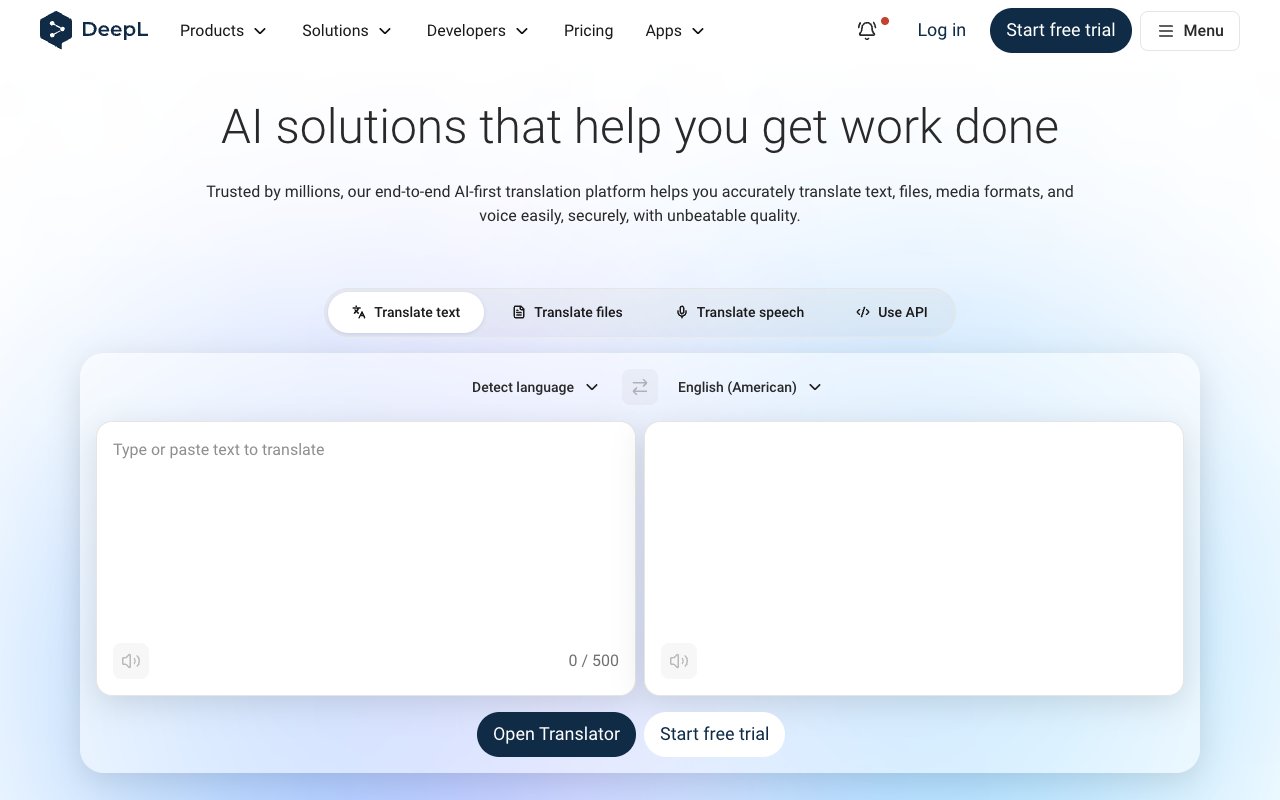
The core product is available at deepl.com as a free web tool. Paste or type text on the left, select your target language, and the translation appears on the right. The free version allows up to 500,000 characters per month — roughly 80,000 words — which covers substantial use for individuals. Three document uploads per month are also included on the free plan.
DeepL Pro adds unlimited text translation, more document uploads, a glossary feature for consistent terminology, and access to the API. The Starter plan at $8.74/month covers most individual professional needs. Advanced at $28.74/month adds team features and higher document usage. Ultimate pricing is custom for enterprise volume.
Document translation is a standout feature. Upload a Word document, PDF, or PowerPoint file, and DeepL translates the content while preserving the original formatting — tables stay intact, font styles are maintained, layout does not collapse. For translation agencies and businesses that routinely translate formatted documents, this saves significant time compared to copying text into a web tool and reformatting the output manually.
DeepL is used by major corporations, law firms, and translation agencies worldwide for professional localisation work. The [DeepL API](https://www.deepl.com/pro-api) integrates with translation management systems used across the industry.
Translation quality: what makes DeepL different
DeepL consistently outperforms Google Translate on quality evaluations for its supported languages, particularly European language pairs. The difference is most noticeable in sentence structure and idiomatic expression. Google Translate produces grammatically correct output that often reads as translated. DeepL produces output that reads closer to how a native speaker would actually phrase the same idea.
This distinction matters more in some contexts than others. For understanding the meaning of a foreign-language document — reading a contract, following a news article, understanding a business email — Google Translate is accurate enough. The meaning comes through clearly even if the phrasing is slightly awkward. For producing text that will be read by native speakers of the target language — marketing copy, legal communications, customer-facing content — the difference between "correct" and "natural" has real stakes.
Independent blind evaluation studies, including those conducted by professional translators, consistently rate DeepL output as more natural for German, French, Spanish, Italian, Polish, and Dutch translations. The advantage is less pronounced for languages at the edge of DeepL's training data, and disappears for languages not in its 33-language set.
For professional translators, DeepL has become a standard tool for generating a first draft that requires less post-editing than alternatives. The industry term is "machine translation post-editing" (MTPE): a human translator reviews and refines the AI output rather than translating from scratch. DeepL's higher-quality output reduces the editing time, which is how it creates value for professional translation workflows even when a human translator is still involved.
For a quick comparison: if you need to translate a business proposal from German to English and send it to English-speaking stakeholders, DeepL will produce a more credible, readable result than Google Translate. If you are translating a menu from Thai, DeepL does not support Thai — use Google Translate.
DeepL Pro features for professional use
DeepL Pro adds three features that matter most for professional translation work: unlimited text translation, document translation with formatting preservation, and glossaries.
The glossary feature allows you to define specific term translations that DeepL must use consistently. If your company's product is called "Dashboard" and must always be translated as "Tableau de bord" in French rather than any synonym, you add that to your glossary and DeepL enforces it across all translations. For brands, legal documents, and technical documentation where consistent terminology is required, this is essential — and it is not available on the free plan.
Document translation handles Word (.docx), PDF, and PowerPoint (.pptx) files. The translated document comes back with the original formatting intact. For a 40-page contract in Word format, this means the translated document is immediately usable — you do not need to paste translated text back into a template and reformat everything manually. For PDF files with complex layouts, results vary by PDF type. Text-based PDFs translate well. Scanned PDFs (images of text) require OCR processing first.
The DeepL Write feature, available separately, goes beyond translation to improve English text for fluency and style — similar to [Grammarly](/tools/grammarly) but with a focus on phrasing and tone rather than grammar and spelling. It is available for English and German currently. For non-native English writers who want to improve their writing beyond grammar correction, DeepL Write and [Grammarly](/tools/grammarly) address overlapping but distinct problems.
For teams needing to translate large volumes of content — a SaaS company localising its interface into six languages, a law firm translating client agreements — the Pro API integrates with content management systems and translation management software. Pricing for API usage scales with character volume, documented at [deepl.com/pro-api](https://www.deepl.com/pro-api).
DeepL vs Google Translate
DeepL and Google Translate are the two most widely used AI translation tools, and the comparison between them is straightforward on most dimensions.
Language coverage: Google Translate supports over 130 languages. DeepL supports 33. For any language outside DeepL's list — most Asian, African, and Middle Eastern languages — Google Translate is the only option between the two. DeepL is not a replacement for Google Translate if you need broad language coverage.
Quality on supported languages: DeepL produces more natural translations for the European languages in its portfolio. Professional translators consistently prefer DeepL output as a starting point for post-editing. Google Translate output requires more correction to reach the same quality level.
Document translation: DeepL's document translation with formatting preservation is significantly better than Google Translate's document upload feature. Google Translate's document handling often loses formatting, particularly in complex Word or PDF layouts. For formatted documents, DeepL is meaningfully better.
Free tier: Google Translate is fully free with no monthly character limit. DeepL's free plan caps at 500,000 characters per month. For heavy personal use, Google Translate wins on cost. For professional use where quality matters, DeepL Pro's pricing is competitive with the time saved on post-editing.
Integration: DeepL has desktop apps for Mac and Windows with a keyboard shortcut that translates selected text from any application. The [DeepL desktop app](https://www.deepl.com/app) makes it faster to use than switching to a browser for Google Translate. For frequent translators, this workflow improvement is a practical advantage.
Who should not use DeepL
Do not use DeepL if you need to translate languages outside its 33-language set. Arabic, Hebrew, Hindi, Thai, Vietnamese, Indonesian, and most African and Middle Eastern languages are not supported. For those language pairs, Google Translate or a specialist translation service is required. DeepL's quality advantage only applies within its supported language set.
Avoid DeepL as a substitute for a professional human translator in high-stakes legal, medical, or certified translation contexts. AI translation, including DeepL at its best, produces errors that a human reviewer must catch. For court submissions, immigration documents, medical records, or anything requiring a certified translation, a professional human translator with legal accountability is still required. DeepL assists professional translators; it does not replace them in certified contexts.
Do not pay for a Pro subscription if you are a casual user whose needs fit within the free plan. 500,000 characters per month and three document uploads cover most individual personal use. The free plan is a genuine product, not a trial — it does not artificially restrict quality or speed.
And if your primary need is writing improvement rather than translation — correcting grammar, improving phrasing in English, polishing business emails — [Grammarly](/tools/grammarly) is more suited to that workflow. DeepL Write handles similar tasks for English and German, but Grammarly's English writing assistance is more mature, with more context-aware suggestions and broader integration across applications.
Our verdict
DeepL
★4.6DeepL is an AI translation service that consistently produces more natural, idiomatic translations than Google Translate. It supports 33 languages, offers a document translation feature that preserves formatting, and has a Pro API used by enterprises and translation agencies worldwide.
Best for
Translating documents while preserving layout and formatting, Professional and business communication in multiple languages
Pricing
Free plan (500,000 characters/month). Starter at $8.74/month. Advanced at $28.74/month. Ultimate custom pricing.
Frequently Asked Questions
DeepL compared to alternatives

Tovorify Editorial
Who reviews these tools →